Showing posts with label Developmental Concepts. Show all posts

Friday, February 18, 2011

"A Picture is Worth a Thousand Words"

This week's post is written by Marcia MacRae, our Interdisciplinary Arts Specialist.  Marcia shares the process of creating a new exhibition in our Good Show Gallery, Chagall Memories.

Young children have the ability to powerfully communicate complex thoughts and deep emotions when given the right vocabulary.  That does not always mean that their message is verbalized.  The incredible artwork in our current Good Show Gallery exhibit clearly demonstrates that, for children, a picture can be the right "vocabulary" - and worth a thousand words.

Work by kindergarten through fifth grade artists at Longwood School in Indian Prairie District 204 vividly demonstrates the importance of quality arts education and experiences for children.  Over 200 students rose to the occasion while exploring the art of famed artist Marc Chagall.  The thought processes they shared while working revealed the deep, personal meaning behind seemingly simple images.

The children understood that the figures symbolically floating through Chagall's paintings were his way of illustrating the characters and traditions that floated through his life.  They used the same visual language to talk about the people, events and ideas that define their lives.

Chagall frequently painted fish as symbols of his father, who worked in the herring business.  Intently referencing their parents' work and hobbies, children portrayed roses, ambulances, fish and books.  A third grade girl drew "Golden light coming out of a church" to represent her mother.  A fourth grader showed herself looking into a mirror, but the mirror showed her mother's reflection, indicating how much of her mother she carried inside of herself.

Children, like adults, have their share of love and joy, fear, anger and sadness. Many choose not to talk about the difficulties in their lives, even if they have the vocabulary to do so.  Utilizing Chagall's joyful, symbol-filled work provided a new vocabulary to express themselves.  Quietly, one girl asked, "Can I do a sad memory?"  The second grader proceeded to draw a rather unhappy scene, but that is not what she turned in at the end of class.  She turned her picture over and completed a happy picture to hang in the gallery.  The fact is, she did not need to complete the sad picture, but she did need to start it.  The process of working out her feeling on paper was more important than the finished product.  Art can give children a powerful vocabulary to stat the thoughts they may not want to speak.  Over the course of nine art periods children drew anger, sorrow, memories of lost relatives and pets and a great deal of happiness.

The rich, thoughtful work in the exhibit did not come out of the blue.  Longwood Elementary is fortunate to have a high-quality art education program.  The children were already accustomed to using a variety of materials to express thoughts and ideas.  All children deserve and need the opportunity to express their thoughts in a wide variety of voices.  Art is language.  Visit Chagall Memories and see what these young artists had to say.

Friday, February 11, 2011

Is Mars/Venus Philosophy True for Children Too?

Yes, men and women are different but when do these differences begin?  Which has a greater influence - genes or environment?  Until recently, most gender studies were conducted on older children and adults.  With today's scientific advances, we are beginning to identify sameness and difference right from the moment of conception.  You would be surprised what is being discovered!

Having grown up with only sisters, and having raised two daughters, I thought I was an expert on female gender strengths and weaknesses.  That is, until I read neuroscientist Lise Eliot's book Pink Brain, Blue Brain:  How Small Differences Grow into Troublesome Gaps - and What We Can Do About It.  Eliot argues that "infant brains are so malleable that small differences at birth become amplified over time, as parents, teachers, peers - and the culture at large - unwittingly reinforce gender stereotypes."  For instance, it has been said that boys are smarter in math than girls. In fact, boys' brains are better wired for certain kinds of spatial reasoning, an attribute needed to be proficient in geometry.  However, if girls are given the opportunity to play with toys that encourage spatial reasoning, such as puzzles, then the slight difference is null.  Some of us may believe, on the other hand, that a girl's brain is wired better than a boy's brain for communication. Interestingly, it is the combination of infant fussiness and caregivers' communication skills during infancy that most influences how good of a communicator each of us becomes. 

The Museum, in partnership with Hobson Cooperative Nursery School, will be hosting a Just for Grown-ups presentation with Dr. Eliot on Monday, February 28.  She will share the latest research and give practical advice for what parents and caregivers can do to help children reach their fullest potential.  Click here for more information or to register for this event.

Friday, October 15, 2010

How Do You Decide Who Gets Your Vote?

How do you prepare yourself to vote? Do you gather all the facts before you make the final decision? Do you discuss your decision with a trusted friend or family member? Have you ever second guessed your decision? Although we don't earn the privilege of voting until we are 18, most children are well aware of elections and voting from an early age, given all the yard signs, phone calls and TV ads they see in their world.

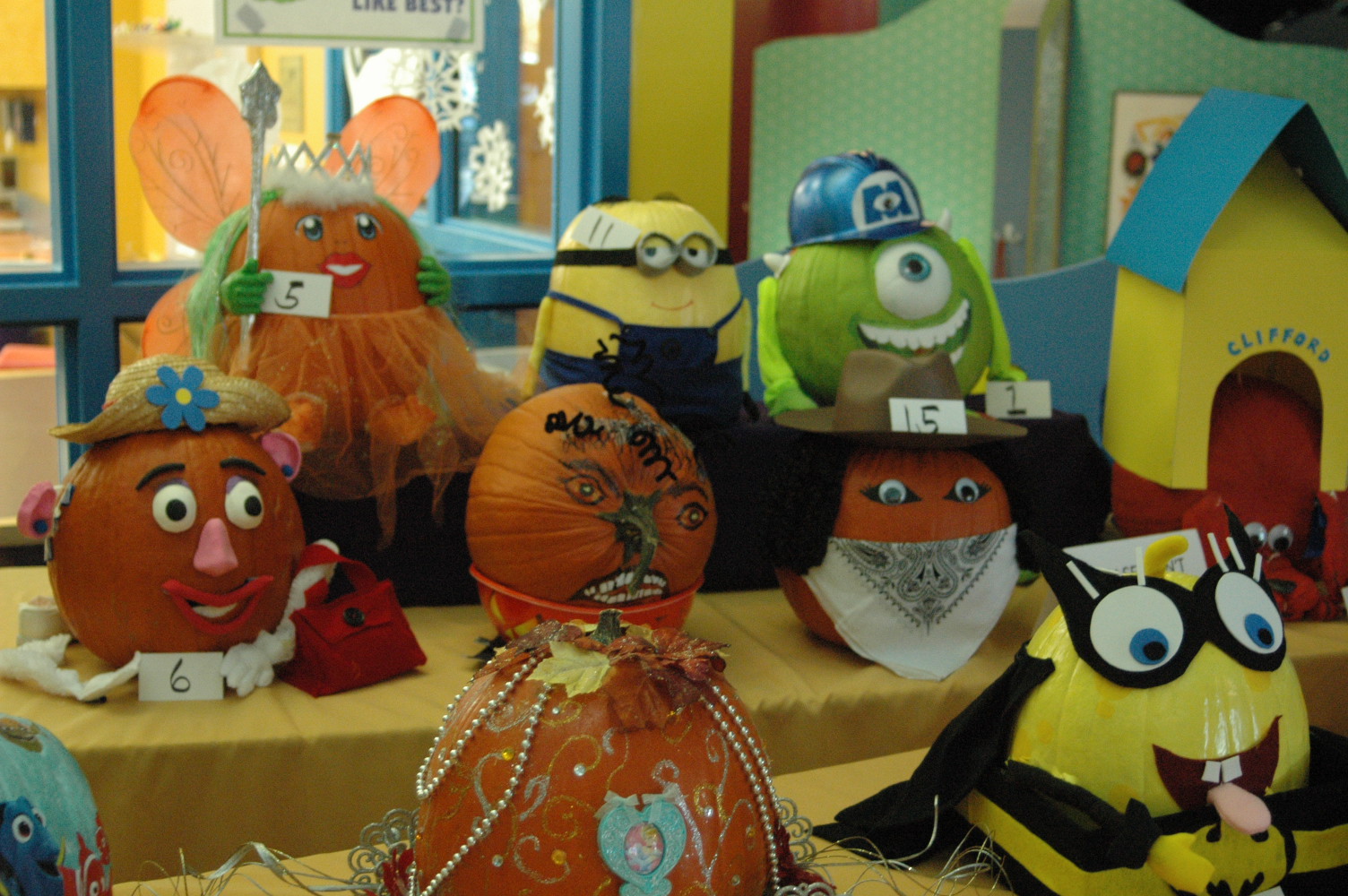
Children visiting the Museum from October 8 - 12 had a unique opportunity to learn about the voting process by casting a ballot for their favorite pumpkin. Expanding upon children's natural curiosity and delight in pumpkin decorations, DCM became the voting place for "The Great Pumpkin Decorating Contest." The submissions were hosted by Brickkicker Home Inspection Company and decorated by area realtors.

A good way to introduce the voting process is to find opportunities for children to practice voting. With younger children, the fewer the choices, the better. Hamburgers or tacos for dinner? Let's take a vote! For older children, the number or the complexity of choices can be increased. You can hold family elections on a variety of topics - where to go on vacation, what movie to watch and so on.

In any election, our own choices may not be the winning ones. When you are practicing voting with your children, make sure you explain how voting works. There's no changing your mind once the ballot is cast! Casting your vote should be a secret. You don't have to share it with anyone. You do have to honor the decision, though!

Voting for a favorite pumpkin was done by placing a ticket in the labeled box, corresponding to the pumpkin of your choice. So what's your favorite pumpkin? You have to make a decision!


And the winner is...

...pumpkin # 17, Purple Cinderella. First runner up is #8, Nemo and second runner up is #3, M & M. The pumpkins have been given to the Nurses' Station at the Pediatric Center at Edward Hospital to be presented to patients when they are discharged to go home!

Friday, September 24, 2010

Science Learning through a Child's Eyes

Scientists use their curiosity about a particular problem to observe, test, verify and make discoveries. How does this curiosity develop? Apparently right from the start! Lise Elliot, author of Pink Brain, Blue Brain, notes that "psychologists have tracked babies' eye movements to gauge whether they understand such properties as gravity, speed, and momentum. Remarkably, they have found that they do!"

Babies explore through their senses. They look, touch, smell, taste and hear just about anything within their reach. You can learn a lot about your child's natural curiosity by observing his/her play and supporting it. A safe environment with objects of varying textures and sounds provides a beginning science exploration for infants. Their favorite object to look at is you! So spend lots of face-to-face time with them!

Older babies and toddlers continue to explore with their senses but now can explore using their increasing motor abilities. Given time to freely explore their environment, toddlers will begin to sort and classify objects. Provide containers of varying sizes and some everyday objects such as balls, large buttons, pom poms, ribbons, lids and bells. These types of open-ended materials foster cause and effect exploration that is basic physics.

Preschoolers tend to center on only one property of an object. For instance, exploring rocks may be about size or shape or color, but rarely about all three attributes. The preschooler's developing language allows him to share ideas and approach problems cooperatively. You can support the preschooler's curiosity by providing short explanations that extend learning opportunities. Try adding a challenge at the end of your explanation. "That rock is shiny when you shine the light on it. Let's try another rock to see if that one shines too."

The early school-age child prefers to solve problems alone or with her peers. The budding scientist is still curious and is more capable of experimentation and increasingly challenging problems. The rock exploration may now be about exploring weight or adding incline planes for experimentation about inertia and momentum as the rocks slide down.

The focus in our Family Resource Center was changed during our shutdown to offer resources related to the topic Making Connections to Science. You can find more information about supporting your child's science explorations both in the FRC and on our website through the end of November. Educating grown-ups about how children learn is a focus of the Museum; it is very important in supporting children's learning both here in the Museum and at home. Because part of our mission is to integrate art, math and science through play, we have chosen to highlight these focus areas in our FRC and on our website to better support the adult's role in the adult-child learning partnership. If you would like more information about science resources offered through the Museum, please contact Jayne Carpenter, Early Childhood Specialist (jcarpenter@dupagechildrensmuseum.org).

For further reading about exploring science through play you may want to view these previous posts:

Exploring the Science of Air
Question, Predict, Try, Analyze and Retry
Explore Shadow Science
Finding Science in Play

Friday, July 16, 2010

Invasion of the Insects!

Anderson Pest Solutions brought their Insect Zoo for our visitors to investigate last week. "The Insect Zoo has developed quite a following with our visitors, having first visited in November of 2009," stated Margaret Hanly, Associate Director of Programs for DCM. "We had 305 adults and children at last week's event," she added. Both children and their parents and caregivers showed a variety of emotions from curiosity to disdain, for these fascinating bugs. And what better way to learn about them: up close and personal and from the pest experts themselves!

How do you feel about bugs? Most of us are either squeamish or enthralled (sometimes both at the same time!). At around age 3, children begin to center their play on make-believe. Playtime consists of imaginary scenarios, mixing what they know with elements of make-believe. During this time, an ant on the sidewalk could be an alien monster. Fears may develop as children go back and forth between figuring out what is real and what is imagined. A natural response of parents is to talk their children out of their fear of the bug. Children, however, respond by cranking up their imagination. Now that little ant might rise up and eat them!

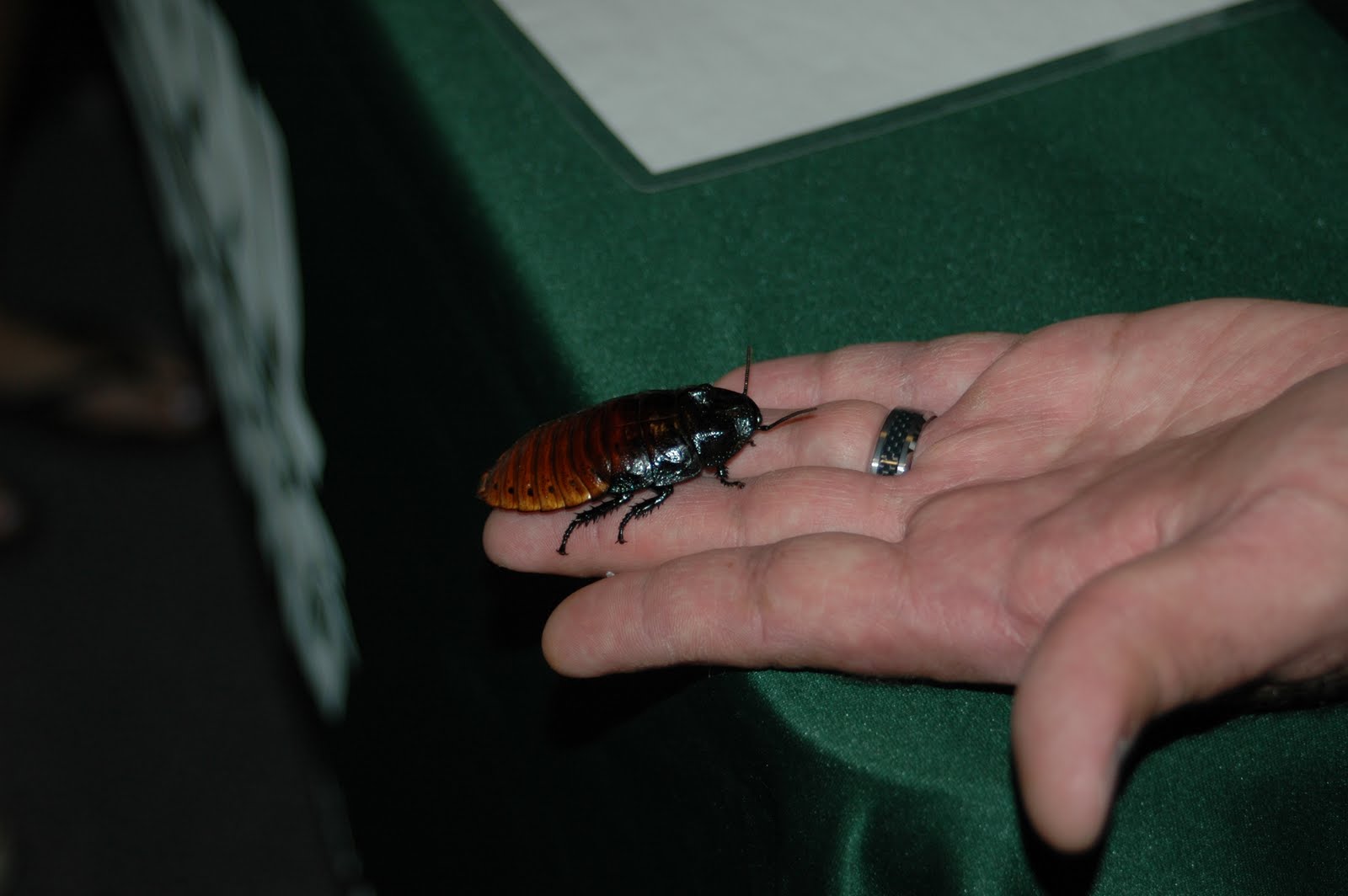
The best way to confront fears is to find ways to play with nonthreatening versions of them. Adults and children alike were able to look at, touch and hear about some very interesting bugs. Fun questions being asked or answers being told were overheard. Do insects have teeth? What do they eat? Where do they live? How do bugs talk to each other? We found out that the hissing cockroach in the picture above lives far away from here, in Madagascar, and communicates by forcing air through breathing tubes that produce hissing sounds. Will the hissing cockroach eat us? No way! He eats only vegetation, mostly decaying fruit.

Children investigated bugs further by looking at books and trying on insect costumes.

Next bug invasion is Tuesday, August 24th. Check the Museum calendar for further information.

Thursday, January 22, 2009

Embracing the Mess and the Noise: Seeing the Importance of Sensory Experiences

Does your child love to pour, fill and repeat in the WaterWays neighborhood? Does she enjoy making and listening to the rattle, shake, and hum of the instruments in the Music Room? Does he seem entranced by the colors and music of the Color My Way exhibit?

Children enjoy (and sometimes even crave) these experiences that stir the senses. And while we as adults do not always crave (or sometimes even enjoy) activities that are messy, wet, or noisy, they are foundational learning experiences.

The Sensory Stage of Learning
Sensory activities are appealing to young children because they are fun and answer the important questions-“What is this?” and “What does this do?” For example, children learn that they cannot hold a lot of water in their hands without it running through their fingertips and down their shirts. Similarly, in a
previous post, we’ve mentioned the importance of mouthing and how it furthers children's understanding of the world around them.


As children get a little older, they may have a better idea of what can be done with objects but continue to need to use their senses to help them test their theories and better answer questions like, “What happens if?” A three-year-old child might learn “If I hit this drum hard, it makes a louder noise.” A five-year-old may mix two or three paint colors together to learn what other colors he can create.

Exploring the Senses With Your Child
Here are some Play at Home and Play at the Museum activities for you and your child:

Touch:
Too cold to go outside, but tempted to play in the snow? Bring the snow inside for some Play at Home fun. Scoop some snow into a large container and bring it inside to explore. Ask your child, How does the snow feel? (Wet, cold, squishy, soft?) If your child prefers, let him play with the snow while wearing his mittens inside. Don’t forget to save some snow in the freezer to bring out for some summer fun!
Using rich vocabulary encourages children to think and talk about the experience.

Vision:
At DCM, the Creativity Connections neighborhood offers many visually stimulating play activities for children. Discover the Light Effects and Shadow Play exhibits and create a light spiral inside the Light Painting Room and your own shadow art in Shadow Lab.
Though shadow and light are not objects that can be picked up or handled, these experiences provide opportunities for investigation and exploration of how light and shadows move, bend, bounce and change in our physical world.

Smell:
Make your own batch of smelly play dough. Mix
your favorite recipe with any flavor of drink mix (Kool-Aid, Wyler’s, etc.) or cocoa powder to create something scented for your child to sculpt and squish. Not only is smell another way for children to investigate their world, but pounding, squishing and feeling play dough are also appropriate outlets for emotional release.

Taste:
Join us at DCM for our Creativity Program, “Makin’ Munchies,” and explore new foods and recipes. During this program, you and your child can create your own healthful treat to try. Watch your child’s reaction to the new food (facial expression or movements). Don’t forget to ask your child, How does it taste?
Cooking experiences give children the opportunity to explore their world using all of their senses.

Hearing:
Inside the Music Room at DCM, children of every age can play and listen to the many sounds created by the xylophones, whale drums and wrenchophone. Using strikers provided, encourage your child to show you what sounds she likes best. You might ask her, Do you like to make loud noises or soft noises?
As children begin to play and listen to music, they learn to respond in creative and meaningful ways.

Want More?
In a future post, we will continue this discussion on the benefits of providing experiences that integrate all the senses and share how every experience is a sensory experience at DCM.

Friday, January 9, 2009

Make 2009 Your Family's Year to Play!

Looking for a New Year's resolution?
According to an article on Psycport.com, Temple University psychologist and past DCM Just for Grown Ups speaker, Dr. Kathy Hirsh-Pasek recently met with parents and psychology and early education experts to discuss the importance of play to innovation and creative thinking. Pasek and others believe that American children will be at a disadvantage in the global economy because of lack of opportunity to play. "Lack of play in early childhood education could be the next global warming...Play equals learning," Pasek stated. "For too long we have divorced the two."


Make a Promise to Play!
One New Year's resolution that will benefit everyone in your family is making a promise to play. Play can happen most anywhere! "Families that play together, build brains together," stated past Just for Grown Ups speaker Jane Healy, Ph.D.


At DCM, we witness children learning through play each and everyday--whether by observing, exploring, creating or wondering. Start your year with a visit to DCM and enjoy a day of play with your family. Looking for at-home play ideas? Check out these past DCM blog posts: Nurturing Children's Curiosity and Wonder in Creativity Connections and Playing IS Learning: WaterWays - Bubbles. DCM also offers free parent resources available in our Family Resource Center and throughout the museum filled with ideas for Play at Home!


Looking for more reasons to play?
Check out our new (and free) Just for Grown Ups resource, Ten Reasons to Make Time for Play. This resource is based on information from experts (including the American Academy of Pediatrics) and recent research supporting the importance of play to a child's overall development and achievement. Additionally, a previous post stated that Jane Healy, Ph.D (DCM's November Just for Grown Ups speaker) also stressed the improtance of "brain building play" and how open-ended, 3-dimensional play experiences promote brain growth.


More Time to Play at DCM
DCM is excited to provide families with more time to play at the museum! Starting January 9th, 2009 join us for Family Fun Friday Nights and enjoy playing together until 8 p.m.

Don't forget!
Register now for our January Just for Grown Ups event with Lilian Katz, Ph.D on January 22, 2009. More information is available on the DCM website or in the following post: January JFGU Event with Lilian Katz, Ph.D

Friday, December 19, 2008

Risk-Taking Relates to Creativity and Learning

Allowing children to take some risks is important for their overall development. In fact, Bay Area Discovery Museum recently published its Top 5 Reasons It's Okay for Kids to Take Risks, following the UK's major study by Play England (part of the National Children's Bureau) and an article in Sunday's The Observer.

Since then, another blog, Open Education has also discussed learning and growing as risky business. In this post, they quoted the study Understanding the Risk Aversion to Risk and also share how Gever Tulley has created a list of "five dangerous things we should let our kids do" and founded a week-long camp called the Tinkering School, where he puts power tools in the hands of second graders. Tulley's camp and the importance of risk-taking have also been featured on NPR's All Things Considered.

While allowing children to take some risks is important, understanding your child's limits is important as well. So how do you determine what risks to allow and encourage your child to take? Here are four things to think about before you decide:

1.) Trust Your Instincts
No one understands your child’s abilities and skills better than you! You also can recognize previous experiences that may make taking risks more challenging. Watch and listen for your child’s cues when deciding whether or not to encourage him to take a risk.

2.) Assess the Situation Together
Talk to your child about the risk and its consequences. Encourage her to share what she thinks would be the best way to respond. This communicates your confidence in her as an active and competent learner. These floors look really slippery. How do you think we should move through this area? I think you are right. We better move slowly through here or else we might fall.

3.) Consider What Could Go Right
Sometimes adults’ own fears can dictate decisions made related to risk-taking. To help recognize the value of the risk, remember to ask yourself—What could go right? As important as it is to ask what could go wrong, it is even more essential to recognize that removing or avoiding the risk may only postpone learning the consequence, skill or how to problem solve the situation.

4.) Model Making Mistakes and Learning From Them
Treat mistakes as learning experiences. You might even share with your child a similar experience you have had. Oops! It looks like there was just too much water in the cup that time. How much water might you try putting in the cup next time to prevent it from spilling?

Friday, December 5, 2008

This Season Give Toys that Teach

Toys are tools for the young. When chosen according to a child's needs, wants or interests they can inspire curiosity and creativity as well as foster motor development, problem solving and thinking skills.

Here are a few tips to guide you as you choose toys that teach your child:

Which Toys for What Age?
According to NAEYC (National Association for the Education of Young Children), each child grows at a different pace, and knowing how your child plays or uses materials will help you choose the most appropriate toys for him/her.

Research has demonstrated that there are some features of toys that are preferred by children, depending on their age/current stage of development. These are appealing, interesting, and appropriate for their physical capacities.

The following are toys preferred by specific age groups:

Infants

  • Infants learn so much from watching themselves or watching others' faces. Unbreakable mirrors that can attach to cribs or changing areas, simple dolls or stuffed animals are often preferred.
  • Younger infants often find simple rhythm instruments that they can kick, bat or shake interesting.
  • Older infants might prefer objects which they can manipulate, put in/take out, or push. These children enjoy nesting cups, stacking blocks or balls to pass or roll.

Toddlers

  • Toddlers are on the move! As they become more capable of moving independently, toddlers want to practice these skills as they play. Toddlers prefer toys such as push- or pull-toys and riding toys that they can move themselves.
  • Older toddlers may begin role-playing with play objects. They may enjoy dressing or pretending to feed a doll, talking on a toy phone or "building" using toddler tools. Children at this age may also prefer role-play using other pretend play toys such as farm animals or vehicles (cars, trucks, etc.).
  • Older toddlers may also enjoy exploring art materials, including paints, crayons, play-doh and/or rhythm instruments.

Preschoolers

  • At this age, children often enjoy extended periods of dramatic play. Props and materials to enhance the experience can include dolls, clothing accessories, large blocks, puppets, kitchen accessories/play food, play money, etc.
  • Preschoolers also may prefer building using a variety of construction toys, including wooden or interlocking blocks.
  • Children might enjoy experimenting with sand and water play materials (cups, strainers, funnels, fish, scoops, etc.).
  • Children are more capable of manipulating smaller objects and may enjoy a variety of puzzles, art materials, patterning tiles or stringing/weaving sets, and sorting or matching small objects.
  • Preschoolers prefer beginner board games. Older preschoolers may also begin playing card games (Old Maid, Go Fish, etc.).

Kindergarteners/School-Age Children

  • Children prefer more specific props and costumes for dramatic play schemes.
  • School-age children prefer to play with action figures.
  • Kindergarteners prefer building more elaborate, detailed structures/models using a variety of construction blocks and toys, wood and real tools (under supervision).
  • Children prefer arts and crafts with more complex materials.
  • Children are more capable of manipulating smaller objects and may enjoy a variety of puzzles, patterning tiles or stringing/weaving sets, sorting or matching small objects.
  • Many prefer guessing games, strategy games or games related to math/words.

(Sources: Early Years are Learning Years Toys: Tools for Learning and The Right Stuff for Children Birth to 8).

Choose Child-Powered Before Battery-Powered

Child-powered toys are those driven by a child's own creativity, imagination or logic. They are more "open-ended," allowing your child to take lead of the play, exploring and mastering the skills at his/her own pace. Many times child-powered toys also allow others (parents, family, friends) to join in the fun and take part in the learning experience. Finally, child-powered toys are usually a better value for parents because they rarely have an age limit. Blocks, dramatic play accessories, art supplies, and pattern blocks are all great examples of timeless treasures - that do not need batteries.

(Source: Toy Action Guide http://truceteachers.org)

Safety First!

According to U.S. PIRG (Public Interest Research Group), "While most toys on store shelves are safe, we continue to find toys that pose a range of safety hazards to small children. As a result, parents and other child-care providers need to remain vigilant in order to prevent toy-related deaths and injuries." The group's pamphlet, "Tips for Toy Safety" can provide families with more information on basic toy safety information. For specific information on toy recalls, check out the Illinois Attorney General's "Play It Safe: Product Recall Guide."


What Are Some of Your Child's Favorite Toys that Teach?

Does your child have a favorite "timeless treasure," an open-ended toy that he/she has or continues to learn by using? Share these by clicking on the "comments" section below.

Did You Know? You Can Find Great Toys at the Explorer Store!
DCM's Explorer Store (found directly across from Visitor Services) is a great place to find creative, fun and educational toys and items related to the Museum's mission. Store hours coincide with Museum hours and admission is never charged to shop the store.

Remember: DCM members receive a 10 % discount at the Explorer Store!

Friday, November 21, 2008


"Nurture Learning By Developing Children's
Innate Dispositions"
An Evening with International Leader
in Early Childhood Education,
Lilian Katz, Ph.D

Thursday, January 22, 2009 7:00-8:30 pm
at TELLABS (1415 West Diehl Road, Naperville, IL)

DCM welcomes Dr. Katz for a practical discussion of how to apply what parents know to develop an active learning partnership with their children. She believes that all children have innate learning dispositions and that how we nurture those dispositions is crucial in encouraging children to become lifelong learners. Dr. Katz has been helping parents and teachers for over 30 years to recognize and support the inextricable connection between knowledge, skills and dispositions in young children so that they become lifelong learners.

Dr. Katz taught at the University of Illinois at Urbana-Champaign for more than three decades and has lectured in all 50 states and in 43 countries. She is currently the Principal Investigator for the Illinois Early Learning Project and continues to lecture and consult around the world. Her new book, Intellectual Emergencies is expected to be available in January, 2009.

Advance Sale Tickets: $15/Member $20/Nonmember
Day of Presentation Tickets: $20/Member $25/Nonmember
DCM program cancellation policies apply.

To register for this event, call (630) 637-8000 ext. 0
For more information, click
here.

This presentation is being generously underwritten by:


Do you have any questions for Dr. Katz?
Post your questions by clicking "comments" below. These questions will be answered by Dr. Katz following her presentation.

Friday, November 7, 2008

Brain-Building Play at DCM

On October 23rd, Jane Healy, Ph.D presented "Your Child's Growing Mind: How Families that Play Together, Build Brains Together" as part of DCM's Just for Grown-Ups lecture series.

Many thanks to those who joined us and we offer special thanks to The Christopher Family Foundation for sponsoring this amazing event!

During the presentation, Dr. Healy discussed how hands-on, open-ended play experiences, like those found at DCM, are essential to children's development.

Experience Shapes the Brain throughout Life
A recent article in The Washington Post states that educators are now looking to neuroscience to offer guidance on what works best in terms of educational strategies. According to the article, the recent revelation that the brain's structure is much more flexible than was previously thought, is helping teachers find ways to create brain-building experiences. In her presentation, Dr. Healy discussed the plasticity of the brain and how experiences indeed shape the brain's development. She states, "New experiences make the brain grow." New experiences strengthen the neurons' potential to take more messages in and send more messages out. This happens, Healy says, as a result of stimulation. We (as children or adults) stimulate our brains and learn when we manipulate ideas and objects.

Brain-building Play
According to Dr. Healy, play is changing. She states that children are becoming more engaged in electronic play that may distort the brain-building process, interrupting development of language, creativity, problem-solving, social interaction skills, and ability to sustain attention. Healy states, "While there is nothing wrong with adding new kinds of play, we need to not forget the power of 3-dimesional, hands-on, object play. These kinds of play experiences stimulate the brain and lay the foundation for children's intellectual, social, emotional and language skills."

Fufilling Children's Need for Brain-building Play at DCM


In today’s world, the type of objects children are playing with and the stimulation they get in return are different than in the past. These different experiences affect how the growing brain "wires itself." Electronic toys and technology provides children with new and different experiences, but Dr. Healy stresses that, "a balance needs to be struck between these experiences and those 3-dimensional, open-ended, hands-on play experiences necessary for children's development." DCM is filled with "brain-building play experiences" for children and families. Healy encourages parents to visit the museum because it is filled with "simple little things" that build children's brains and allow for open-ended, child-centered play. "The very best play is 90 % child and 10% toy," says Healy. "Families there (at DCM) together can learn to play, release stress, build brains...and clearly I think the children's museum is a fabulous place."


To hear Dr. Healy's entire presentation, please click here:


Save the Date!
Join us on: Thursday, January 22nd, 2009

Lilian Katz, Ph.D
International Leader in Early Childhood Education
as she presents,

"Nurture Learning by Developing Children's Innate Dispositions"

Fees: Advance Sale - $15 members/$20 non-members
Day of Presentation - $20 members/$25 non-members

To register, call (630) 637-8000.

Wednesday, October 15, 2008

Nurturing Children's Curiosity and Wonder in Creativity Connections

(This is the third in a series of postings directly related to each of the DCM neighborhoods.)

Creativity Connections was designed on the premise that sensory experiences (visual, sound and tactile) can stimulate children’s understanding of learning concepts. Sensory experiences stimulate children’s curiosity and wonder and can inspire children to ask questions like Why? and How? It is from these experiences that children gain a better understanding of how the world works and learn about many concepts related to math, science and the arts.

These are just a few of the sensory experiences you might find inside Creativity Connections:

-Color My Way: children can compare how their drawings change inside the Color Booth, create a design at Color Dots or with Picasso Blocks or describe how their environment looks through a Colored Pane.

-Music Room: children can create rhythms/patterns on a Slit Drum, explore the feel of a Babydinda or Amadinda or feel the vibrations emitted from a Whale Drum.


-Light Effects, Table and Kiosk: children can wander through the Mirror Maze, experiment with form in the Light Painting Room, create their own window using Stained Glass Blocks or place vinyl shapes at Window Art.

Creativity Connections is a great place to begin wondering about the scientific concepts of shadow/light, color and sound. A child's interest and familiarity with science come from active engagement at an early age. Each of these experiences provide children with opportunities to explore aspects of their world and develop skills necessary for scientific thought - observation, investigation/asking questions and experimentation.


"Although young children have been described as “natural” scientists, they are afforded few opportunities for learning not only science concepts and content but also the functions and structure of scientific language, discourse, and processes" (Patrick, et al., 2007).

Creativity Connections can spark your child's curiosity and wonder -- and you can encourage and extend their learning by:

-Welcoming and embracing children’s questions

To help nurture children’s inquiry, communicate positive responses to their questions—no matter how many!

  • Provide a positive response. This will communicate to the child that their thoughts are important and that you encourage their curiosity. If the moment isn’t right, assign a time for the two of you to talk about the concept later. Can we talk about this at lunch? I’m going to think about it till then.

-Giving answers that extend learning opportunities
Provide children with a short explanation that can reinforce a concept and open the door to future investigations.

  • Add a challenge to the end of an answer. I see you've made a rainbow with the prism. What would happen if you pointed the light in another direction?

  • Connect the explanation to something they already know or are familiar with. The prism breaks up the light and creates the colors of the rainbow, just like the raindrops did to the sunlight outside that day we saw a rainbow at the park.

-Instead of “I don’t know,” try “Let’s find out!”
Let children take the lead role of scientist by encouraging them to problem solve and figure out the answer to some of their questions.

  • Young children may need your help to get them started. Start by offering suggestions. Allowing children to predict, observe and test their theories are important steps of the scientific process. What would happen if you hit the other end of the drum?

  • Follow up after the experience by asking your child to repeat back what he or she has learned. How did you make your picture green? What colors did you use?

Next time:
Learning and growing is risky business! In a future blog post, we will take a look at a recent post from Bay Area Discovery Museum on the importance of taking risks. We will talk about how taking risks can promote creativity and problem solving. We will then provide a few questions for adults to think about as they determine what risks to allow and encourage children to take.

Friday, August 8, 2008

Algebra in the Museum?!

Algebra in the early years establishes the necessary groundwork for ongoing and future mathematics learning. -Jennifer Taylor-Cox

Recently we discussed the recently re-opened Math Connections neighborhood and how it highlights many math concepts, including algebra. But what does algebra look like at DCM?

In the article "Algebra in the Early Years? Yes!" author Jennifer Taylor-Cox describes the central ideas of algebra and illustrates ways they can be applied to young children's activities and experiences. These concepts, "enhance children's natural interest in mathematics and their disposition to use it to make sense of their physical and social worlds."

The central ideas of algebra that are described within the article are also the core concepts of the many exhibits and activities found in DCM's Math Connections neighborhood. Below are some exerpts taken from Taylor-Cox's article, describing each central idea. We have also described how children can explore these four ideas inside Math Connections at DCM.

Central Idea #1: Patterns

"'Recognizing, describing, extending, and translating patterns'"

In Math Connections, children can explore symmetry, create patterns with shape and color or create 2-D or 3-D patterns.

Try this: Encourage children to point to each color or shape as they "read" patterns throughout the neighborhood. For example: red, blue, red, blue, red, blue.


Central Idea #2: Mathematical Situations and Structures

"'Experiences with mathematical situations and structures through representations and analyses of equality'"

Children can explore representations and the concept of equality in Math Connections.


Try this: As you explore the neighborhood, use words like equal/not equal, same/different, more/less, balanced/unbalanced.


Central Idea #3: Models of quantitative relationships

"'Explore models of quantitative relationships in a real-life context"

Throughout the neighborhood, children can push individual or sets of beads or manipulatives together to represent different values.

Try this: As you play with manipulatives, narrate the child's actions. You might say, You pushed 5 red beads and 2 white beads; that's 7 beads! Ask questions like, What other ways can you make 7?

Central Idea #4: Change

"'The understanding that most things change over time, that such changes can be described mathematically, and that changes are predictable'"

In Math Connections, children can explore change related to size, shape and measurement.

Try this: Encourage children to use words like bigger/smaller, shorter/taller to describe objects, structures or creations. You might ask, How many blocks tall is your tower?


Tell us about a moment you have shared with a child who was thinking "algebraically" as they played at DCM!


Thursday, July 24, 2008

Exploration and Play: From Staff to Visitor

As staff of a children's museum, our jobs not only allow us the opportunity to experiment and play, but also often require we do so! The many great examples of what our experimentation and play have generated can be seen in each of our neighborhoods and exhibits. However, the fun doesn't end once an exhibit is on the floor. The experimentation and play continue as we add and alter these exhibits to enhance the learning experience for our visitors.

At DCM, exhibit staff generally follow a process in which they collaborate with the Museum's early childhood specialist and interdisciplinary arts specialist to discuss developmental goals and outcomes before brainstorming prototypes, observing their use, reviewing the model and offering a final product. But what happens when they want to improve or maintain an existing piece?

Mark Wickart, Manager of Exhibit Fabrication and Maintenance, states that since he began working for DCM seven years ago, "Everthing here we have made stronger." Existing exhibits need to be maintained, fixed or sometimes altered to enhance visitors' experiences.

One recent example of an exhibit which we have some fun revisiting is our Baby Wind Garden, inside the Build It Young Explorers neighborhood. The exhibit is designed to introduce infants and toddlers to the concepts of air, shape and surface. Young children experiment with cause and effect, trial and error and the sensory experience created by wind spouts and the many manipulatives (small balls and scarves) provided.

Staff noted that although the Baby Wind Garden exhibit did indeed introduce these concepts, it was not attracting visitors. It was at this point that Wickart began to brainstorm permanent manipulatives that would be immobile but draw attention and interest to this exhibit. Prototypes using plastic bottles of different kinds and ribbons, yarn and pompoms of different weights were created and observed by floor staff. Wickart drilled several holes in bottles and jars in an attempt to adjust airflow and alter materials' movement to create maximum visual stimulation.
This trial and error process continued until a plexglass cylinder containing one pompom was placed over a wind spout in the garden. Staff observations demonstrated increase in interest, the brightly colored pompoms' movement drawing attention to the exhibit. The prototype was a success! From there, the stronger, more durable and larger model currently in use was created. Able to now hold more pompoms, once over the wind fountains the contents create a "popcorn" movement - which draws infants and toddlers attentions to explore and interact with this exhibit.

Look What I See! See What I Learn!

These young children toddled over to take a peek at the "popcorn" jars in Baby Wind Garden and were soon giggling and laughing, enjoying the sensory experience of playing in the "wind." Mom then picked up a small ball and demonstrated the Bernoulli Effect (objects floating on streams of air). Soon both boys were experimenting with balls, large and small trying to create Bernoulli Effects themselves. Mom did a great job modeling vocabulary like air, wind, and float during their time in the exhibit.

As a museum professional, have there been times where you have found yourself using play and experimentation or trial and error to make improvements on an exhibit? Share these with us!

Monday, July 14, 2008

A Summer Stop for Everyone!

Designed for children up to the age of ten, DCM offers interactive, open-ended, fun experiences for everyone! Whether it is the exhibits within our seven neighborhoods or our daily drop-in programs developed around the integration of the arts, math and sciences, there are many shared experiences for multiple age and developmental levels within your family.

Whether it is your first visit or a returning trip, if you are a family with school-aged children, here are a few ways to explore a children's museum:

No Agenda Necessary.
Overwhelmed by overscheduling? Too many camps and classes? Children's museums offer a place that does not pose an agenda. Children can explore and problem solve whichever of the over 150 exhibits they choose.

Empower active investigation.
Older children begin to understand more complex vocabulary and concepts related to specific subject matter. Older children are also often more attentive and can stay at a task longer. They may enjoy exploring familiar materials, but seek out challenges and opportunities to problem solve.

At DCM, the exhibits empower children to set their own pace, transcending age and experience. The following is one example of how exhibits provide learning opportunities for the entire family from the Museum's neighborhood, Make it Move:

An older boy experiments with ways to extend a ramp at Ramps & Rollers, while his infant sister sits nearby with Mom. The sister puts her hands in a bucket of balls and dumps them out on the floor. “Mom, watch!” the boy says. He places a golf ball at the top of his ramp and together they watch it move down and finally off the bottom onto the floor. It rolls past the infant, who begins to then scoot over towards it, but stops. She reaches for it. Together, the boy and mom laugh. “How could you make the ball roll closer to Jessie?” the mom asks. The boy then rotates the ramp and adds another section to the end to extend the ramp closer to his sister. He then leans a few plastic cards from the Maxi-Rollway against the wooden ramp pieces, as if to create even more of a barrier to further position the ball’s path toward his sister. Mom rolls a golf ball in the infant’s direction as she watches the boy construct his new plan. She then offers her daughter a lighter whiffle ball to explore. “Where do you think the ball will roll now?”

The questions asked by the mother above provided the boy with a challenge and provided him with an opportunity to practice using his problem solving skills. All the while, she was able to facilitate play with her infant. Here are a few more questions you might ask a school-ager:

·
What could we make using all of the (Giant Tinker Toys, blocks, ramps)?
· Can you make a bubble inside another bubble?
· Do you think we could draw a family portrait in Glow Art?
· Why do you think a foam ball floats on the wind spout, but not a yarn ball?


Check the DCM Calendar or What's Happening? sign.
Daily Drop-in programs, including storytellers, musical guests, and Studio projects are some of the many arts programming planned throughout the summer. These special programs are meant to be interactive for the varying age groups that visit the Museum. One of the many benefits your child will receive from arts programming is the opportunity to use and understand symbolic communication.

Enjoy the memories.
Hands-on activities, like those found throughout the Museum, can nurture children's learning at any age. "When you are part of what you are learning--you are going to remember it better," says Chris Barry, School Programs Manager. "To memorize that a cube has six sides is one way to understand its dimension. However, to touch and create a 3-dimensional, six-sided shape is another." This kind of hands-on exploration creates memories. “Children learn the most from memorable experiences." She states that children reference pleasurable experiences they have had, throughout their lives.

As you and your family have fun and learn together, notice the achievements, developmental milestones and concepts being grasped and new skills being mastered. Remember: Talk about what you do together! You might be surprised at what your children have discovered!


How do you interact with older children while at the Museum? Let us know! To join the conversation, click on "comments" below!


Check This Out!
We want to know: Who's reading the blog? Let us know by clicking on the poll found at the top of the How Learning Comes in to Play! site. You can also always let us know by leaving us a comment anywhere throughout the blog. We hope to hear from you soon!

Friday, June 6, 2008

Neighborhood Navigations: Build It Young Explorers - Play with Me!

Build It Young Explorers offers opportunities for even our youngest visitors to interact and experiment with gravity, motion and construction. The neighborhood provides multiple sensory experiences and unique materials (many of which are designed and built by Museum staff).

Pushing and Pulling, Rolling and Spinning—Introducing Scientific Concepts
Similar to the Build It and Make It Move neighborhoods in the Museum, many of the objects found in Build It Young Explorers can be pushed, pulled, rolled, or spun. The objects’ differences in size, shape or texture often create different effects and make children wonder –Why?

Older infants or toddlers often approach Baby Ramps and Rollers after following a ball that has rolled past them or watching a model (such as a parent, caregiver or older sibling) demonstrate the task involved. Your child might hunt for more round objects to place on the ramp and repeat the experiment to see how they roll down each ramp. What scientific concepts do you think this activity demonstrates?

While young children are not going to understand words like gravity, motion or physics, the use of simple science and math words, like up, down, over, under, fast, slow, big and small, heavy and light, will introduce them to these scientific concepts. Additionally, what are some other things you might do to engage your child during this experience?

Here are some ideas:

  • Enjoy wondering with your child! Ask questions that begin with "Why?" or "How do you think we could?" You may not know the answers, but by sharing your thoughts with your child you model language and problem solving skills.
  • Try something different. If you notice your child placing several small balls on the ramp to see what will happen next, hand him or her a larger ball and see what happens. Does your child push the ball aside or attempt to place it down the ramp (even if it doesn't fit)? Another challenge is to hand a third ball to your child while he or she is already holding one in each hand. Does your child drop a ball to pick the new one up or does the child put the other two down first and then return to get the third?

Source: "Starting Children on Science." Early Years are Learning Years. National Association for Education of Young Children.


Enhancing every area of a child's development
An infant crawls through the tunnel in Build It Young Explorers and stops to look at his mother, who is seated at the opposite end watching. The mother says, “Are you inside the tunnel?” The child smiles at her and then looks down. It seems as if he is looking at the bumpy mat he needs to cross to get to his mother. “You can do it,” she says to the young boy. He quickly crawls up and over the bumpy mat to get to his mother. As he reaches her knees, she says, “You made it! You went over!”


When asked why she sat at the end of the tunnel and spoke to her son as he navigated his way through, the mother said she did this “just to let him know I was there.” Simple interactions like this can help children understand how to put their ideas into action to accomplish a goal; practice crawling, balance and coordination; and/or build self-confidence. Parents and caregivers that are active participants in their child’s play further nurture the development of not only cognitive skills, but also problem solving, social and emotional, gross motor and language and communication skills as well.

How Learning Comes in to Play—At-Home!
Encouraging, modeling and wondering can happen at home. Here are a few materials you can use to simulate experiences in Build It Young Explorers:

  • Blocks: Infants and toddlers enjoy building (and of course knocking down) stacks and towers using soft blocks, small wooden blocks, duplos or interlocking blocks. Use simple math and science words like tall or short.
  • Balls: According to the article, "What is Age-Appropriate Play for Young Children?" from the Illinois Early Learning Project, "Once a baby begins to crawl, toys that can be pushed or rolled and chased across the floor encourage physical activity and interaction with other people." Experiment using boxes, blocks or paper towel tubes to create ramps of all kinds. Introduce concepts related to motion and gravity by using words like fast, slow, up, down, over, under and through.

  • Scarves: Infants and toddlers seem almost entranced by an object's movement. Their eyes follow the objects, often motivating them to try to move, reach and grasp. Scarves move in many ways and are a great sensory tool because often you can see through them, creating a visual and tactile experience. Play peek-a-boo; drop the scarf above your child and ask, "Where is it going to go?" or try playing with the scarf outside on a windy day.

Source: Illinois Early Learning Project. http://illinoisearlylearning.org/faqs/playage.htm


Want More Information? Check this Out:
The Partners in Play cards found in each of the three Young Explorers areas of the Museum provide parents and caregivers with child development information and suggestions on how to engage infants and toddlers in play.

Stay Tuned!
Math Young Explorers is back and with a new look! In a future post, we will chat about the impact that environmental design and aesthetics can have on children’s play and development.