Showing posts with label Museum Information. Show all posts

Wednesday, March 23, 2011

Teens Inspire Young Children through Chagall

This is a second post about the Chagall Window's Project at DCM by Marcia MacRae, our Interdisciplinary Art Specialist. Read about how the Chagall inspired art panels created by area teens inspired our young visitors in the Museum.

While the high schoolers were ready to paint for the DuPage Children's Museum's Chagall Windows Project, they were not prepared for the reactions of the Museum's young visitors.  Fascinated toddlers watched every stroke with their noses pressed to the windows of our Studio.  Several young elementary school children were in awe, disappointed that they could not join in the project, but proud to proclaim that they wanted to be artists when they grew up.  The high school artists were seen as heroes:  young enough to relate to, yet old enough to be impressive inspirations.

Initially, we had hoped to interest several high school artists in this project.  We were stunned by the response.  Why would over 50 high school students want to spend their free time doing something for a children's museum?  We discovered that the opportunities to create art for the public and to inspire young children were powerful draws for this group.  Perhaps they were inspired watching teenagers work when they were youngsters.  Whether creating the art or toddling past it, this DuPage Children's Museum venture was a winning endeavor for all ages involved!

The high school students were honored at Chagall Windows reception, hosted by NBC news reporter Lauren Jiggetts.  You can view photos of this event on our Facebook page.

Wednesday, March 16, 2011

Teens Inspired by Chagall

This week's post is written by Marcia MacRae, Interdisciplinary Arts Specialist for DuPage Children's Museum.  Marcia shares with us the process of  creating the Chagall Windows project with local high school students in conjunction with our temporary exhibit, Chagall for Children.

Inspired by Marc Chagall's stained glass America Windows, recently reinstalled at the Art Institute of Chicago, 50 students and their art teachers from 7 area high schools interpreted the idea of "children at play" in his style.  The students shared their creativity and skill with their collaborative teams, with the children visiting the Museum and, now, with everyone passing the Washington Street windows of DCM.

Dreaming of Adventures
Many of the high school students recalled fond memories of childhood visits to the Museum, but far from playing, they took this project on with great seriousness, arriving with carefully detailed sketches or complete life-size drawings.  Many gave up weekends and multiple afternoons to accomplish their goals.  Each team knew they would receive four-foot square, clear panels and a quantity of acrylic paint. Otherwise, they were free to conceptualize their own versions of the subject.  Look closely and you will see elements taken from the Museum's website, local landmarks, Chagall's art and from the students' personal memories of childhood play.  The finished works are as unique as the artists themselves.
Inspired by the Wind Tunnel in AirWorks

Inspired by Dandelion Fountain at the River Walk in Naperville

Inspired by exhibits in Make It Move
Stay tuned!  Next week's post will highlight how these teen artists inspired some of our younger visitors!

Tuesday, March 8, 2011

Using Observations to Modify Exhibits

In a second post about our Museum's prototyping process, Peter Crabbe, Associate Director of Exhibits and Design, shares how we use observation during prototype experiences at DCM.

After creating a prototype we temporarily install the exhibit on the Museum floor to see what kinds of interactions our visitors will have.  Trained observers, who act as our eyes and ears, write a detailed description of what happens at the prototype as children play with it.  The observers are often Museum volunteers.  The volunteer observers are extremely important to us because, unlike the exhibit developer, designer, or fabricators, who are very close to and vested in the project, they tend to observe more impartially.  Even with the best of intentions, the people working closely designing and developing the project will be more inclined to see only what they want to see.

After a few observations, we collect all the field notes and look to see what the children and families have been doing with the prototype.  We will often see something similar written in almost all the field notes: if such a trend emerges, it prompts us to modify the prototype and then observe again to see if modification improves the exhibit.  For example, we are currently observing a prototype for a new version of our Roller Coaster exhibit because we want children to find it physically easy to use in joining the pipes together and we want it to encourage a more free form type of ramp and tube building in the space provided for this experience.  I have visions of the children making large curvilinear tube ramps wrapped around columns like a spiraling amusement park ride or configuring tubes in which balls build momentum going down a steep run only to go back up again before making their final descent to the exit.  From reading the field notes, however, it is clear that we need to cut some shorter tubes and observe the prototype again to see if it is easier for younger as well as older children to use.

Building exhibits is expensive.  Prototyping is a way to ensure that an exhibit not only looks engaging, but also meets its educational goal, is intrinsically interesting and fun for children, and makes clear to people what the exhibit is inviting them to do.

We keep records of the field notes and the prototyping summary so that they can be useful for the future.  Our hope is that the body of work will be a basis for future Museum staff who will one day develop other exhibits at DCM.

If you want to see the final product, stay tuned!  In a future post we'll share how we determined the design changes and show you the final product, our new and improved Roller Coaster exhibit.

Tuesday, March 1, 2011

Exhibit Prototyping

This week's post is written by Peter Crabbe, Associate Director of Exhibits and Design for DuPage Children's Museum.  Peter will be sharing a series of posts for our readers this month about our Museum's prototyping process.  Leave a comment or ask a question as we look at this process together.

The exhibit prototyping process is one of the favorite parts of my job here at DuPage Children's Museum (DCM).  It's our opportunity to find out if what we have predicted on paper will actually work in practice or  to test out something that we are unsure will work.  Prototyping exhibits helps us to finalize their design to a point where we are confident that the final product is something that children will find interesting and fun, and meets the educational goals of the exhibit.

Children often surprise us, using the exhibit prototypes in unexpected ways.  This helps us to modify what we are doing to better meet their needs, which can mean tweaking what we intended, re-designing or even going in a completely different direction we hadn't intended!

We use the prototyping stage to answer questions about practical issues, such as how high off the ground to make something so children can easily reach it, how to engineer something and the best way to ensure that the exhibit is safe.  Finally, it is a chance for us to invite our visitors to participate in helping us create and improve the experiences at DCM.

How does the prototyping process work?  Once we have figured out what an exhibit is about and what type of exploration we want to encourage in children, we typically do a rough sketch or concept design.  Sometimes we can't answer all our questions, such as how interesting children will find the exhibit, if it will work technically or if people will know what to do with it without signage just from looking at a sketch or drawing; that's when we need to prototype.  Our fabricators will then build a rough prototype in our Museum fabrication shop.  The prototype is a temporary structure made quickly and inexpensively, and left unpainted.  However, any working or moving parts have to be fully functional.  Sometimes the prototypes have a distinctly Rube Goldberg look about them.

Stay tuned!  Find out about our visitor interactions with prototypes in a future post!

Monday, January 17, 2011

Exploring the Art of Chagall with Children

The Museum is very excited to offer our visitors the opportunity to explore, touch, listen, to learn about, look at, wonder about and feel the art of Marc Chagall.  Based on the work of this Russian-born French painter 1887-1985, the exhibit includes 15 reproductions of Chagall works, most with interactive elements that allow children to explore their own creativity. The exhibit is located in our Creativity Connections neighborhood from January 15 - April 20, 2011.

"Recurring themes in Chagall's work," according to our Interdisciplinary Arts Specialist, Marcia MacRae, are his love of family, his town and the way he was brought up.  It's those kinds of memories we want to make for our children."

Here are some suggestions for exploring the exhibit together:

Use your senses. Most of the reproductions and all of the accompanying exhibit  interactive components are designed to be explored. Marc Chagall's art appeals to the senses - look with your eyes, pretend to smell the flowers, hear the music or feel the fine textures.

Encourage your child by asking questions. Ask your child to tell you what he sees, hears or feels. Whether he's pretending or describing a real action, these opportunities nurture the development of your child's thinking and inquiry skills.

Cultivate curiosity. Allow your child the opportunity to move at his own pace. Tune in to his interests and then support his discoveries by reading the labels or prompts.

Relate what you see to something familiar. Chagall was struck by the beauty of French flowers. Talk about the flowers in your garden or home. Recall a time when flowers were purchased for a special occasion.

Extend the learning. Where else in our Museum do you see artwork? Explore and talk together. How is the artwork the same as Chagall's? How is it different? Pretend to be one of the characters in a Chagall painting on the main stage in our Interact with Art Gallery, Play's the Thing: Act II, located on the second floor.

Please take time to visit this inspiring exhibit. Leave us a comment or send us a picture through this blog! What did your child notice first? Extend the learning at home by challenging your child to draw a picture as Marc Chagall did.

The Chagall for Children traveling exhibit was developed by Kohl Children's Museum and premiered in July 1996 in Wilmette IL.

Tuesday, January 4, 2011


Our ninth annual celebration to ring in the New Year (at noon) was a resounding success! I can't think of a better way to ring in the New Year than to watch the delight of children, parents and grandparents creating, celebrating and pretending together.

Singing along with Mr. Singer and the Sharp Cookies

Making a jet-pack to blast-off to 2011

Coloring in the "Galaxy Room"


Countdown to noon with Mayor George Pradel


Ringing in the New Year with bubbles

To view more pictures and read stories about our New Year's countdown to noon celebration, visit the Daily Herald and patch.com/NapervillePatch.

(Pictures are compliments of volunteer photographers Kelly Bridges, Caryn Kolodziej and Rick Beato)

Wednesday, December 8, 2010

Have you visited the Family Resource Center Lately?

With a very comfy chair and lots of parent and teacher resources, the Family Resource Center (FRC) might just be the place to visit next time you are in our Museum. Located on the second floor, this tucked-away area not only serves as a respite on busy Museum days, but also provides a lot to see and do - quietly.

Stories and Books
Grab a book and share some cuddle time with your child or enjoy one of our many story reading and story telling opportunities offered throughout the week. They all support your child's growing literacy skills! Check the calendar for the daily schedule of events.

Table Top Activities
While you're resting or looking at resources, your child may enjoy exploring the teddy bear and elephant counters. These counters provide endless exploration with sorting by color, counting and pretending. Other table top activities include stacking blocks, Large Leggos® and puzzles. As he develops his skills, the emerging artist in your child may want to draw a picture with crayons or chalk using the drawing resources available in the FRC.

Parent and Caregiver Resources
Finally, a welcome surprise for many of our visitors is the variety of books and resources for parents and caregivers available in the FRC. The books are for you to peruse while visiting the Museum. You will find a designated shelf of parent support books and topical focus books about art, math, science or play. A recent addition to our library, donated by Perseus Book Groups, The Secure Child by Stanley L Greenspan gives timely advice for helping children feel safe and secure in a changing world.

A sign outside the FRC indicates what the current focused topic is. Presently our focus is about the arts. Teachers and parents may want to look through the variety of art curriculum books. One of our many books, Discovering Great Artists, Hands-on Art for Children in the Styles of the Great Masters by MaryAnn F. Kohl and Kim Solga, offers 110 unique art activities for children to experience the styles and techniques of the great masters from the Renaissance to the present. If you would like your own copy of one of the suggested books, support the Museum by using our Shop and Grow Program on our website.

Enjoy some of our former posts about visual art, dramatic art and storytelling opportunities in the Museum.

Thursday, November 11, 2010

What Makes a Good Field Trip?

What was your favorite field trip when you were a child? What made it so memorable? Besides being thrilled to be out of the classroom, you probably got to interact with a fascinating guide, creative spaces or new materials in a way you had not experienced before. The interactions you had with your classmates may have helped make it memorable as well.

So what makes a good field trip? Good field trips connect to what children are learning. Authentic experiences that relate to and expand on previous knowledge can make powerful educational connections. For teachers, good planning must precede field trips. Teachers and caregivers should familiarize themselves with the site prior to booking a field trip. Parents want to know that their child will be safe and that the trip serves a planned educational purpose. If parents accompany their children on well-planned field trips, they can support their child's learning at home - and become the best advocates for future visits.

An increasing number of our volunteers under age 30 are reporting their memories of field trips at DCM. In particular, they recount experiences from our learning lab field trips. Our learning labs are memorable because they integrate what children are learning in school with their developmental interests and abilities. Teachers like them because they are well organized and align with the Illinois Learning Standards.

Do you have a favorite Museum field trip memory?. Post a comment with a group compiling those memories here. If you have a favorite field trip memory from DuPage Children's Museum, leave us a comment on our blog.

Consider booking a field trip with us soon!

Friday, November 5, 2010

Good Toy Choices

We will be hosting our third annual toy show and sale on Friday, November 12. With so many good toy choices both during the sale or any time in our Explorer Store, how do you choose? Here are a few suggestions to consider:

At any age, co
nsider puppets. When children play with puppets, they make them talk, encouraging the development of language skills and the expression of various emotions. Add a puppet stage (also available in our store and at the sale) and you've got a performance!

I like to keep these Magic Noodles (colored biodegradable peanuts and sticks) around when friends stop by with their children or grandchildren. Just add a damp paper towel and let the creativity take center stage. This activity helps children to think spatially, and the ideas are endless. Read about how we use biodegradable peanuts in the Studio here.

In consideration of
older children, we've added science kits to our collection of learning toys this year. Create your own mechanical moving robot or choose a kit where you can design a hovercraft or praxinoscope. School-age children are ready for figuring out how things work. Your child's increasing concentration and problem solving abilities are challenged when they explore the complexities of a science kit.

For more information about the toy show and sale, click here. Our Explorer Store is always open during Museum hours. You don't need to pay admission to visit the store. Consider a trip to our Explorer Store this holiday season.

Please enjoy additional tips
from a previous post to guide you as you make good toy choices!

See you at the sale on November 12th!

Friday, October 15, 2010

How Do You Decide Who Gets Your Vote?

How do you prepare yourself to vote? Do you gather all the facts before you make the final decision? Do you discuss your decision with a trusted friend or family member? Have you ever second guessed your decision? Although we don't earn the privilege of voting until we are 18, most children are well aware of elections and voting from an early age, given all the yard signs, phone calls and TV ads they see in their world.

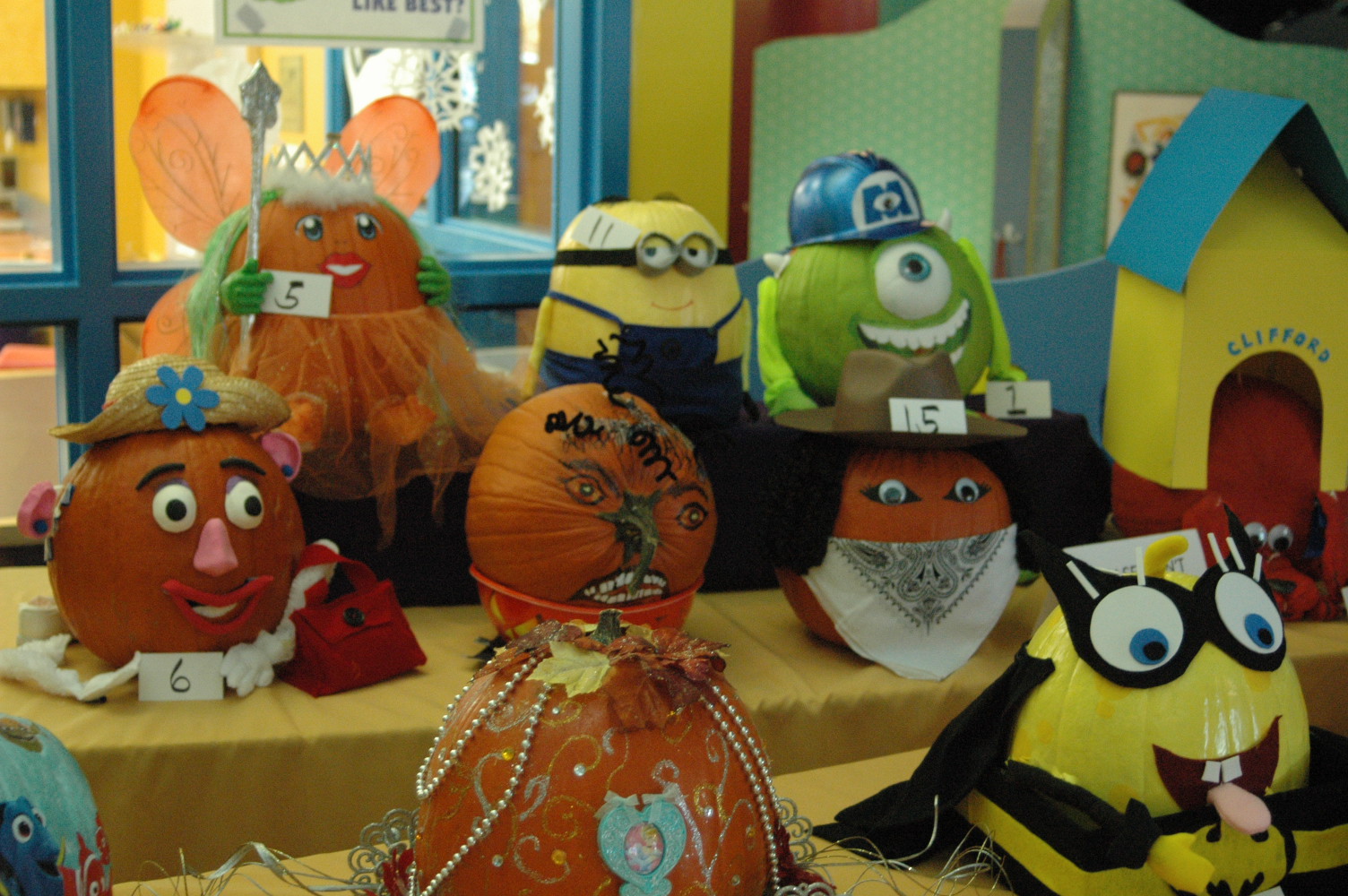
Children visiting the Museum from October 8 - 12 had a unique opportunity to learn about the voting process by casting a ballot for their favorite pumpkin. Expanding upon children's natural curiosity and delight in pumpkin decorations, DCM became the voting place for "The Great Pumpkin Decorating Contest." The submissions were hosted by Brickkicker Home Inspection Company and decorated by area realtors.

A good way to introduce the voting process is to find opportunities for children to practice voting. With younger children, the fewer the choices, the better. Hamburgers or tacos for dinner? Let's take a vote! For older children, the number or the complexity of choices can be increased. You can hold family elections on a variety of topics - where to go on vacation, what movie to watch and so on.

In any election, our own choices may not be the winning ones. When you are practicing voting with your children, make sure you explain how voting works. There's no changing your mind once the ballot is cast! Casting your vote should be a secret. You don't have to share it with anyone. You do have to honor the decision, though!

Voting for a favorite pumpkin was done by placing a ticket in the labeled box, corresponding to the pumpkin of your choice. So what's your favorite pumpkin? You have to make a decision!


And the winner is...

...pumpkin # 17, Purple Cinderella. First runner up is #8, Nemo and second runner up is #3, M & M. The pumpkins have been given to the Nurses' Station at the Pediatric Center at Edward Hospital to be presented to patients when they are discharged to go home!

Friday, October 8, 2010

Displaying Children's Art Reaps Powerful Rewards!


The best art openings in town are at DuPage Children's Museum's Good Show Gallery, a special venue for displaying children's works. The artists arrive, some in fancy dress, some straight from hockey practice, all excited to show their families the works they created in a DCM workshop. Pointing out their thoughtful creations to parents and recognizing their artistic efforts hung behind glass in an official art gallery generates tremendous pride. At one artists' reception a father shared that his daughter reminded him of the exhibit opening celebration every single day after she participated in the workshop. That morning she bounded into his room to wake him with, "Don't forget! It's tonight!"
Showcasing children's creative effort has far-reaching results. Beyond encouraging thoughtfulness in the work, gallery showings offer the opportunity to document children's increasing skills and problem-solving abilities. Our Good Show Gallery's mission is to support DCM's Scribbleosophy©, a document honoring the developmental stages in children's growing creative abilities. Displaying the work of entire classes demonstrates to parents the fact that everyone, from gifted Monet to the average doodler, goes through the same stages at roughly the same age. (While not documented, it is likely that even Rembrandt's figures looked like tadpoles at the age of 3!).

While it's cookies and juice at DCM's Good Show Gallery openings, rather than wine and cheese that are provided in Chicago's art district, be assured, the excitement and pride of every artist is a work of art.

This week's post is written by Marcia MacRae, DCM's Interdisciplinary Arts Specialist. For more information about the Good Show Gallery, contact Marcia at mmacrae@dupagechildrensmuseum.org

Monday, September 13, 2010

What's New at DuPage Children's Museum?

We are pleased to welcome our visitors back! After a two-week refresh and cleaning of the Museum, we are open! A Play Facilitator was overheard saying, "Boy, does this place smell clean!" Cleaning and sanitizing takes priority all year round but especially during our annual shutdown. You can read more about our daily and yearly cleaning procedures here and in a 2008 article in Hand to Hand Journal for the Association of Children's Museums (ACM).

A major change during our shutdown was the refreshing of our Interact with Art Gallery, The Play's the Thing, now called The Play's the Thing: Act II. The main purpose of our gallery is to help our young visitors and their adult partners realize that there are many creative ways to interpret the world and that their own interpretations have validity. Like its predecessor, The Play's the Thing: Act II offers opportunities for pretend play, performance, puppetry and set design. Pretend play is a wonderful way to facilitate development of imagination. When children role-play, they often practice taking on the perspective of others.

You will notice that the Main Stage was moved to the other side of the exhibit. A plain back-drop was added so children can manipulate their own props with Velcro®. You will also see a Play Note that prompts the visitor with a performance idea.

The Tower has been transformed into a Rocket, which, along with the Space Station, Space Mural and Saturn Bench, children can use to expand their performance ideas into outer space. For more information about The Play's the Thing: Act II read an article in the Daily Herald newspaper here.

Stay tuned! The Family Resource Center's focus is Stepping into Science. In our next post we'll look at some of those resources and the exploration of science through play.