
Yes, men and women are different but when do these differences begin? Which has a greater influence - genes or environment? Until recently, most gender studies were conducted on older children and adults. With today's scientific advances, we are beginning to identify sameness and difference right from the moment of conception. You would be surprised what is being discovered!
Having grown up with only sisters, and having raised two daughters, I thought I was an expert on female gender strengths and weaknesses. That is, until I read neuroscientist Lise Eliot's book Pink Brain, Blue Brain: How Small Differences Grow into Troublesome Gaps - and What We Can Do About It. Eliot argues that "infant brains are so malleable that small differences at birth become amplified over time, as parents, teachers, peers - and the culture at large - unwittingly reinforce gender stereotypes." For instance, it has been said that boys are smarter in math than girls. In fact, boys' brains are better wired for certain kinds of spatial reasoning, an attribute needed to be proficient in geometry. However, if girls are given the opportunity to play with toys that encourage spatial reasoning, such as puzzles, then the slight difference is null. Some of us may believe, on the other hand, that a girl's brain is wired better than a boy's brain for communication. Interestingly, it is the combination of infant fussiness and caregivers' communication skills during infancy that most influences how good of a communicator each of us becomes.
The Museum, in partnership with Hobson Cooperative Nursery School, will be hosting a Just for Grown-ups presentation with Dr. Eliot on Monday, February 28. She will share the latest research and give practical advice for what parents and caregivers can do to help children reach their fullest potential. Click here for more information or to register for this event.
Showing posts with label Parent Involvement. Show all posts
Showing posts with label Parent Involvement. Show all posts
Friday, February 11, 2011

Monday, January 10, 2011
Learning to Look
Quality art and design are everywhere you go! Learning to look at art and design not only helps develop art appreciation, but can also foster many important skills children need for lifetime learning! Make it a new year's resolution to look at art and design with your children. Here's some great tips from our Interdisciplinary Specialist Marcia MacRae:
Learning to Look Everyday
Start by hunting fo r simple colors or shapes with young children. Note every time you see the color red while running errands. You'll be astounded by how much your child will find. Building powers of observation and concentration will go a long way in developing study skills.
Older children are ready to make comparisons and judgments about objects. For example, help your child notice differences by inviting comments of the windows of the houses and shops near home. You'll be surprised at how many different types of windows you may discover in your neighborhood.
Helping children develop judgment and aesthetic sense fosters an ability to form opinions. At any age, point out a building or sculpture and tell your child what you think of it. Ask their opinion and let them know it is OK to disagree. Showing your children that their ideas are worthwhile, even if different from yours, helps them respect the opinions of others.
 Learning to Look in the Museum
DCM is filled with art and designs for children to notice. All of our artwork is chosen to make connections with the learning goals of our exhibits. You can count along with Andy Warhol's 100 Campbell Soup Cans in Math Connections; trace the curving design of our cloud-shaped tables in AirWorks; build zigzagging ramps like the three different artistic interpretations of San Francisco's famous Lombard Street in Make it Move; or work on wonderfully textured surfaces in one of the exhibits in Creativity Connections.
Observation, appreciation of design, and good descriptive vocabulary are skills needed in science and math as well as art. Practice taking a new look at these things you see everyday. Talk about them with your children and they'll make new discoveries and connections in the world around them.
Learning to Look Everyday
Start by hunting fo
 r simple colors or shapes with young children. Note every time you see the color red while running errands. You'll be astounded by how much your child will find. Building powers of observation and concentration will go a long way in developing study skills.
Older children are ready to make comparisons and judgments about objects. For example, help your child notice differences by inviting comments of the windows of the houses and shops near home. You'll be surprised at how many different types of windows you may discover in your neighborhood.
Helping children develop judgment and aesthetic sense fosters an ability to form opinions. At any age, point out a building or sculpture and tell your child what you think of it. Ask their opinion and let them know it is OK to disagree. Showing your children that their ideas are worthwhile, even if different from yours, helps them respect the opinions of others.

 Learning to Look in the Museum
DCM is filled with art and designs for children to notice. All of our artwork is chosen to make connections with the learning goals of our exhibits. You can count along with Andy Warhol's 100 Campbell Soup Cans in Math Connections; trace the curving design of our cloud-shaped tables in AirWorks; build zigzagging ramps like the three different artistic interpretations of San Francisco's famous Lombard Street in Make it Move; or work on wonderfully textured surfaces in one of the exhibits in Creativity Connections.
Observation, appreciation of design, and good descriptive vocabulary are skills needed in science and math as well as art. Practice taking a new look at these things you see everyday. Talk about them with your children and they'll make new discoveries and connections in the world around them.

Wednesday, December 8, 2010
Have you visited the Family Resource Center Lately?
 With a very comfy chair and lots of parent and teacher resources, the Family Resource Center (FRC) might just be the place to visit next time you are in our Museum. Located on the second floor, this tucked-away area not only serves as a respite on busy Museum days, but also provides a lot to see and do - quietly.
Stories and Books
Grab a bo ok and share some cuddle time with your child or enjoy one of our many st
 ory reading and story telling opportunities offered throughout the week. They all support your child's growing literacy skills! Check the calendar for the daily schedule of events.
Table Top Activities
While you're resting or looking at resources, your child may enjoy exploring the teddy bear and elephant counters. These counters provide endless exploration with sorting  by color, counting and pretending. Other table top activities include stacking blocks, Large Leggos® and puzzles. As he develops his skills, the emerging artist in your child may want to draw a picture with crayons or chalk using the drawing resources available in the FRC.
 by color, counting and pretending. Other table top activities include stacking blocks, Large Leggos® and puzzles. As he develops his skills, the emerging artist in your child may want to draw a picture with crayons or chalk using the drawing resources available in the FRC.
Parent and Caregiver Resources
Finally, a welcome surprise for many of our visitors is the variety of books and resources for parents and caregivers available in the FRC. The books are for you to peruse while visiting the Museum. You will find a designated shelf of parent support books and topical focus books about art, math, science or play. A recent addition to our library, donated by Perseus Book Groups, The Secure Child by Stanley L Greenspan gives timely advice for helping children feel safe and secure in a changing world.
A sign outside the FRC indicates what the current focused topic is. Presently our focus is about the arts. Teachers and parents may want to look through the variety of art curriculum books. One of our many books, Discovering Great Artists, Hands-on Art for Children in the Styles of the Great Masters by MaryAnn F. Kohl and Kim Solga, offers 110 unique art activities for children to experience the styles and techniques of the great masters from the Renaissance to the present. If you would like your own copy of one of the suggested books, support the Museum by using our Shop and Grow Program on our website.
Enjoy some of our former posts about visual art, dramatic art and storytelling opportunities in the Museum.
A sign outside the FRC indicates what the current focused topic is. Presently our focus is about the arts. Teachers and parents may want to look through the variety of art curriculum books. One of our many books, Discovering Great Artists, Hands-on Art for Children in the Styles of the Great Masters by MaryAnn F. Kohl and Kim Solga, offers 110 unique art activities for children to experience the styles and techniques of the great masters from the Renaissance to the present. If you would like your own copy of one of the suggested books, support the Museum by using our Shop and Grow Program on our website.
Thursday, November 18, 2010
Instilling a Sense of Giving
Back when no curbside recycling existed, my sisters and I used to help our mother collect recycled materials to take to the volunteer-staffed recycling center. Although this experience started me on a philanthropic path, at the time I only knew it as a way of life. We looked at the adventure as fun!
Instilling a sense of giving can start early! Children three and under are primarily focused on themselves. A sense of giving is learned by watching grown-ups. When children observe adults share, listen or be kind to others, they learn compassion. "Giving" can mean your time or treasures. In this season of giving thanks and helping those less fortunate with food or gifts, you are modeling compassion! Even very young children can help shop, assemble and wrap donated items.
Support your philanthropic ideals via picture books, too, like The Giving Tree by Shel Silverstein, The Giving Box by Fred Rogers or the classic Stone Soup.
By the time children start school, they are ready to be more involved in their own philanthropic adventures, usually centering on their own interests. After hearing about our Champions campaign, two second graders donated the proceeds from their lemonade stand to the Museum. Children's charitable involvement contributes towards raising self-esteem, developing social skills, fostering an introduction to the greater world and encouraging kids to appreciate all that they have.
Make giving a family affair by encouraging your children's interests and working together. By allowing them input and decision-making, you will start them on the path of lifetime giving!
(This article first appeared in the November (2010) issue of Positively Naperville - PN Monthly. This month's featured column, Raise Your Play I.Q.® is written by Jayne Carpenter, M.S. - the Early Childhood Specialist for DuPage Children's Museum. She has degrees in Child Development and Applied and Family Child Studies. As an Early Childhood Specialist, Jayne has a diverse background with a variety of experience in museum, parent, teacher and child learning programs spanning 30 years. Contact her at the Museum or via email at jcarpenter@dupagechildrensmuseum.org.)
Friday, October 22, 2010
Grandparent Play
 While we value grandparents everyday at DuPage Children's Museum, we celebrate their unique bond with their grandchildren during the month of October. Bonnie Strong, a grandmother visiting from Ohio in honor of her grandchild's 3rd birthday, commented that DCM is a great place for wonderful memories!
Do you remember the bond you had with your grandparent? It's as if time stopped and the world revolved around the two of you when you explored and played together. Grandparents typically have more time to share in the excitement of their grandchild's new discoveries. While all adults can be important in a child's life, grandparents often fill the role of friend, play partner, role model, caregiver, family historian, mentor and a source of unconditional love.
Being a grandparent offers many benefits too! According to an article from Forever Families, the grandparent role provides a chance to participate in a child's growth and development without the level of responsibility that parents have. An added bonus can be a sense of vitality for grandparents who explore and play with someone in a younger stage of life!
(Parts of this post are from Raise Your Play I.Q., a column in the October 2009 Positively Naperville Newspaper, by Jayne Carpenter, Early Childhood Specialist for DCM)
(Parts of this post are from Raise Your Play I.Q., a column in the October 2009 Positively Naperville Newspaper, by Jayne Carpenter, Early Childhood Specialist for DCM)
Wednesday, August 18, 2010
Great Big and Teeny Tiny
Measurement is the main way most of us use math in the everyday world. From great big to tiny, measurement begins with noticing differences in size. Although preschool children may not verbalize measurement, they are thinking about it - from how tall they are to comparing how long their teddy bear is next to their friend's bear. During last week's Preschool Summer Camp we used the creative arts to explore size differences. We painted with teeny tiny brushes (and tiny fingers) and large brushes (and large hands). We compared space by using small and large paper. After reading the book Where's My Teddy, a delightful story about a mix-up of two teddy bears, one belonging to a small boy and one to a large bear, we decorated small and large teddy bears. We took small pieces of biodegradable Styrofoam pieces and created large sculptures. A large box filled with shoes, from baby shoes to clown shoes, not only provided for fun make-believe, but also generated conversations about size comparisons.
Using the exhibits in Water Ways and Math Connections, we explored quantity, size and balance. You too can facilitate learning by using early math vocabulary such as small/large or more/less/fewer when playing in these exhibits with your preschooler.
Explore measurement at home by offering varying sizes of paper. Pennant-shape paper allows children to draw naturally and encourages them to create tiny and large designs. Puzzles are another great way to explore size differences. Read more about puzzle play here.
Enjoy this week's montage of pictures. We sure had a fabulous time exploring measurement!
Wednesday, August 11, 2010
Let's Pretend
During last week's Preschool Summer Camp, the focus was pretend. Pretending is a great way to encourage and motivate children's learning. One of the many benefits of pretending is that it gives children many opportunities to practice using their memory.
We started the week by cultivating our storytelling techniques with volunteer storyteller Joanne Chase. On Monday we created stories with story blocks and then created our own story blocks and story boards. On Tuesday we made up stories with puppets and made puppets to take home. On Wednesday we reenacted the story Caps for Sale by Esphyr Slobodkina. We used our imaginations in the exhibit neighborhoods, too: on the Main Stage, in the U-Drive and in the Cat'sTower, which are located in our Interact with Art Gallery, The Play's the Thing. By the end of the week we were making costumes and creating sets. A visit from performers of Cirque Shanghai surprised and delighted us as we watched in amazement with other Museum visitors.
For more information about pretend play, we recommend two of our favorite staff resource books at DCM. Both books can be ordered through DCM's Shop and Grow Program.
Einstein Never Used Flashcards by Kathy Hirsh-Pasek, Roberta M. Golinkoff and Diane E. Ayer
Awakening Children's Minds: How Parents and Teachers Can Make a Difference by Laura E. Berk
Tuesday, August 3, 2010
Cool Chemical Concoctions

 Bubble, fizz, ooze! These were some of the results last week at our Cool Chemical Concoction Mini-Camp for 7-9 year old children. At one of the four mini-camps for younger school-age children held this summer, children experimented with common household "chemicals" to learn about the power of CO2 gas, how yeast makes dough rise, how to grow crystals, how to make several different cool slimes and much more!
You don't need to be a scientist to explore science! Because of children's natural curiosity, it's easy to get them interested in science. Visit your local library and look up books about kitchen chemistry. Some of our favorites include Science Experiments You Can Eat by Vicki Cobb, Kitchen Chemistry: A Book of Science Experiments by Evan Moor and Kid Chemistry by Sandra Ford Grove. You can find these books on-line through our Shop 'n' Grow Program.

So - discover what's inside your cabinets for experiments. Don't forget to stand back when you drop the Mint Mentos® into the Diet Coke.
Tuesday, June 15, 2010
Exploring Physics in Childhood
 How did you explore the concepts of physics when you were a child? Do you remember the toy, Slinky? This was a toy that helped you intuitively learn physics. My sisters and I each owned a Slinky and had races with them down the stairs in our house. We were experimenting with how fast or slowly we pushed the Slinky off the steps, in actuality, an inclined plane. A physicist would have told us we were experimenting with force versus distance.
You don't have to be a physicist to explore the concepts of physics; you just need the right materials for exploration and discovery. Some concepts of basic physics involve exploring motion, gravity, friction and speed while using simple machines such as wheels, gears, pulleys, incli
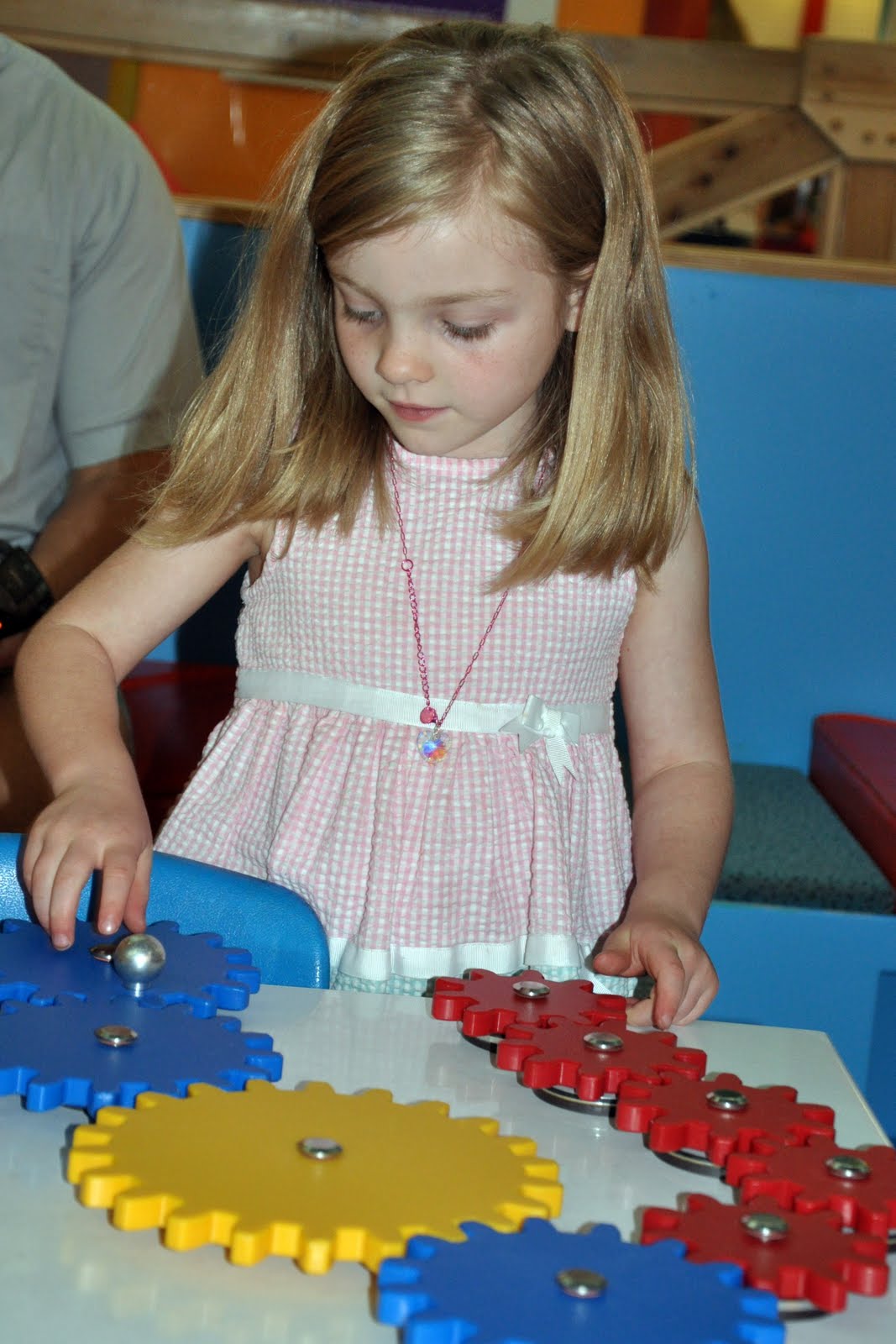 ned planes, wedges, screws and levers. The exhibits in Make it Move (MIM) were developed so that children could explore some concepts of basic physics while playing with simple machines. As children play with the exhibits in MIM, they can begin to intuitively understand some of these concepts and, with the support of their grown-up play partners, learn the vocabulary to describe them. Look at how many words (bold) we can use to describe simple machines and some of the basic concepts in physics.
Children explore gears at our Gear Table. Here they discover that a gear is a wheel with teeth, which allow it to interlock and turn another gear. They may also notice the ratio between a bigger and smaller gear.

Playing at our Cam Ball Lifter, children observe cams, which are wheels or gears with an offset axle used to make something happen in a specific order. Here it does just as the name implies; it lifts the ball towards the funnel for increasingly greater energy in motion for the awaiting ramps.
Speaking of ram
 ps, there are lots of opportunities to discover that ramps are inclined planes that help the speed of a ball move more easily, slower or faster. A simple machine that does the work for us! After all, isn't that what working with simple machines is all about, that is, using a force to
 move an object a distance?
The momentum of the object at the Experimentation Station may vary depending upon what object is chosen. Even our youngest visitors can be observed experimenting with balls and spools down one ramp and trying out the car on the magnetic levitation (mag lev) ramp.
To learn more about the design and building of the exhibits in Make it Move, read an interview with Mark Wickart, Exhibit Fabrication and Maintenance Manager; and Peter Crabbe, Associate Director of Exhibits and Design, here.
If you and your child would like to explore (and have fun) with a Slinky, you can purchase one in our Explorer Store.
Friday, May 7, 2010
Happy Mother's Day
Mother's Day is an annual holiday recognizing mothers, motherhood and maternal bonds, in general, as well as the positive contributions they make throughout society. Did you know that Mother's Day is celebrated in other countries, typically sometime between the months of March through May?
Every day is Mother's Day at the Museum as we honor their incredible contributions to their children's learning. As important grown ups in their lives, mothers and grandmothers play a vital role as they and their children learn and interact together. Here are some suggestions to support your child's learning the next time you're in the Museum.

In honor of Mother's Day we are posting a few pictures of mo ther and grandmother interactions in our Museum.
Join our Flickr group and share pictures of your visit here.

Every day is Mother's Day at the Museum as we honor their incredible contributions to their children's learning. As important grown ups in their lives, mothers and grandmothers play a vital role as they and their children learn and interact together. Here are some suggestions to support your child's learning the next time you're in the Museum.

In honor of Mother's Day we are posting a few pictures of mo
 ther and grandmother interactions in our Museum.
Join our Flickr group and share pictures of your visit here.

Tuesday, April 27, 2010
Your Child and Sharing
 Most of our young visitors are of the mindset, "What's mine is mine and what's yours is mine too!" Some of our grown up visitors may get upset when they see their two-year-old not sharing something in our Museum. You can facilitate your child's understanding by, first, understanding what they are capable of and, secondly, creating an environment that helps children become aware of other children and each other's boundaries.
One way to support this stage of development is to ensure plenty of supplies. This supports a child's sharing abilities while maturation and perspective-taking experiences are developing.
Here's some information about sharing from the Museum's parent support materials which can assist in awareness of your child's changing development and offer tips to support your child's growing understanding of his social world.
Check out other parent support resources here.
Monday, April 19, 2010
Observation through the Use of Photographs
In a previous post we discussed the value of observing children playing and interacting in the Museum. When you sit back and watch your child interacting with materials and other children in the Museum, you may delight in a growing understanding of his ever-changing development, both cognitively and socially.
Observing first before interacting may not always be an option. If you brought your camera to the Museum, you have another tool for finding out what your child can do. You can look at your photos after your visit and discover something you may not have observed earlier. Let's take a look at some pictures and see what they tell us:
 These children look as if they are discovering that air blowing through the tubes is keeping the ball (and the attached ribbons) suspended above the tube. The exhibit in AirWorks offered these children multiple opportunities to experiment in ways that may have surprised them. Their obvious enjoyment of the activity looks as if it's keeping their interest. If these two children don't know each other, you may have also discovered your child's interest in sharing the experience with another child.
Looking at this picture together, after a visit, offers opportunities to continue discovering what your child learned. Your child may offer comments about what she thinks about air or how she discovered the surprise of the ribbons standing straight up in the air. Extend the learning by going outside on a windy day and predict what the air outside can do with balls.
In this picture, taken in our WaterWays Neighborhood, this child is exhibiting good concentration as she pours the water into an opening on the top so that the water wheel below will turn. She may be experimenting with how pouring fast (or slowly) affects how fast (or slowly) the wheel turns. We are definitely reminded about how concentration plays a role in learning and completing a task. I wonder what this child is thinking when she's experimenting with water. Perhaps she's making a connection to something she saw outside. Further investigation can happen when caregivers and children look at photographs together.
So the next time you're in the Museum, take time to observe what's happening. Use your photographs to learn more about your child's growing interests and extend learning opportunities for yourself and your child!
Observing first before interacting may not always be an option. If you brought your camera to the Museum, you have another tool for finding out what your child can do. You can look at your photos after your visit and discover something you may not have observed earlier. Let's take a look at some pictures and see what they tell us:
 These children look as if they are discovering that air blowing through the tubes is keeping the ball (and the attached ribbons) suspended above the tube. The exhibit in AirWorks offered these children multiple opportunities to experiment in ways that may have surprised them. Their obvious enjoyment of the activity looks as if it's keeping their interest. If these two children don't know each other, you may have also discovered your child's interest in sharing the experience with another child.
Looking at this picture together, after a visit, offers opportunities to continue discovering what your child learned. Your child may offer comments about what she thinks about air or how she discovered the surprise of the ribbons standing straight up in the air. Extend the learning by going outside on a windy day and predict what the air outside can do with balls.
In this picture, taken in our WaterWays Neighborhood, this child is exhibiting good concentration as she pours the water into an opening on the top so that the water
 wheel below will turn. She may be experimenting with how pouring fast (or slowly) affects how fast (or slowly) the wheel turns. We are definitely reminded about how concentration plays a role in learning and completing a task. I wonder what this child is thinking when she's experimenting with water. Perhaps she's making a connection to something she saw outside. Further investigation can happen when caregivers and children look at photographs together.
So the next time you're in the Museum, take time to observe what's happening. Use your photographs to learn more about your child's growing interests and extend learning opportunities for yourself and your child!
Wednesday, April 7, 2010
Celebrate Week of the Young Child
Celebrate the Week of the Young Child April 11 - 17, 2010
The Week of the Young Child (WOYC) is an annual celebration sponsored by the National Association for the Education of Young Children, the nation's largest organization of early childhood professionals. This week-long celebration recognizes and honors more than 35 million children from birth through age eight as well as the families, teachers and others who help them make the most of their learning opportunities in the early years.
In honor of this year's theme, Investing in Young Children Benefits All, DuPage Children's Museum and the Naperville Park District have teamed together to create an entire week of free events for our community including a celebrity story reading, a concert and many more child- and family-friendly activities. For a schedule of all the Week of the Young Child events, click here.
Join us for this week long celebration as children bring communities together!
Friday, March 26, 2010
Observe First Before Interacting in Play
So you've come to the Museum to play and interact with the children you brought with you. You might be a  caregiver, parent or grandparent. Before joining in on play, take a few minutes for some spontaneous observations. What you see and hear may offer some possibilities into what can be learned about a child's personality, developmental capabilities, problem solving abilities, interests, knowledge, expressions of culture or reasons behind behavior. These facets of understanding, as mentioned in our last post, offer you as a parent, grandparent or caregiver a fuller and richer picture so that you can be more successful in supporting your child in play.*
Let's see, for instance, what observation may teach us about a child's personality. While on the Museum floor with a special activity, The Toddler Slide, two important grown-ups each had a chance to observe their child interact and negotiate the shared space of the Toddler Slide. This space is designed for only one child to use at a time:
Now Grandma may already know that her granddaughter is cautious. What she learned today was that her granddaughter uses her cautious behavior to assess the situation before joining in playing with others. Cautious children are typically good observers. This is a trait that can be beneficial when she's older and with her peers, without parental influence.
So next time you're in the Museum, take time to discover something new about your child's personality. What do you learn when you observe children playing at the Museum? Send me your story and we may use it on a future post.
*For more, see Focused Observations by Gaye Gronlund and Marlyn James.
 caregiver, parent or grandparent. Before joining in on play, take a few minutes for some spontaneous observations. What you see and hear may offer some possibilities into what can be learned about a child's personality, developmental capabilities, problem solving abilities, interests, knowledge, expressions of culture or reasons behind behavior. These facets of understanding, as mentioned in our last post, offer you as a parent, grandparent or caregiver a fuller and richer picture so that you can be more successful in supporting your child in play.*
Let's see, for instance, what observation may teach us about a child's personality. While on the Museum floor with a special activity, The Toddler Slide, two important grown-ups each had a chance to observe their child interact and negotiate the shared space of the Toddler Slide. This space is designed for only one child to use at a time:
One boy, visiting with his mother, showed no fear in climbing up the 3-step stairs and sliding down the slide. A more timid visitor, a little girl, staying close to her grandmother, watched the little boy go up and down the slide. When the boy went back to playing nearby with his brother, she approached the slide and with affirmation from grandma, climbed up the stairs and slid down the slide. She smiles at Grandma, pleased with her feat. When the boy returned to the slide, her confidence had increased enough to share the space with him, with a little verbal help from Mom and the Early Childhood Specialist. (Saying, "your turn, her turn" helped define the negotiated space.) The boy's mother brought baby brother over to slide down and big brother gave him a gentle push. Noticing this interaction, the girl went back to watching others on the slide but eventually joined the boy and his brother on the slide.What did Mom and Grandma learn about personality with this observation? While Mom may already know that her son has confidence in his abilities to navigate slides, she may have noted what he's learning about sharing space with others, that is, his willingness to take turns as long as the other person keeps up with his pace. (Note: I have the same expectation. If you go shopping with me - keep up the pace - we're on a mission!) Her gentle reminders can help with his eagerness, until he is developmentally ready to slow down his pace for others.
Now Grandma may already know that her granddaughter is cautious. What she learned today was that her granddaughter uses her cautious behavior to assess the situation before joining in playing with others. Cautious children are typically good observers. This is a trait that can be beneficial when she's older and with her peers, without parental influence.
So next time you're in the Museum, take time to discover something new about your child's personality. What do you learn when you observe children playing at the Museum? Send me your story and we may use it on a future post.
*For more, see Focused Observations by Gaye Gronlund and Marlyn James.
Friday, March 19, 2010
What Can You Learn by Observing Children?
Observation is a powerful tool! All of us observe, informally, as we go about our daily lives. We watch and listen to our surroundings. At a store I may notice the number of people near a kiosk or display and wander over to see what is catching everyone's interest. I may overhear a conversation about the latest movie release that sparks my interest to see a movie I had not planned to see. Observation can reveal information we may not have known before.
Do you ever wa tch children at play? When we take the time to observe children during play, we gain understanding about who they are and what they can do. Our Play Facilitators observe children playing and learning throughout their day. In fact, observation is the first method of facilitation recommended for staff and volunteers who interact with our visitors. Watching and listening allow facilitators to take their cues from what they see and hear children doing before deciding whether to join in an interaction. It gives the facilitator pause to reflect on what the child's play agenda is before interacting with the child.
In their book, Focused Observations, How to Observe Children for Assessment and Curriculum Planning, Gaye Gronlund and Marlyn James identify seven facets of understanding about children, when we take time to observe them. Whether you are a facilitator, caregiver, parent or grandparent, observation can provide us a "thorough and well-rounded picture of what is important to know about children" (Gronlund and James 2005).
"Learning about the information and knowledge children are constructing" is one of the facets of understanding mentioned in Gronlund and Jame's book. Here's an example of what that means, as observed by one of our Play Facilitators in our Math Young Explorer Area.
Stay tuned! Over the next few posts, we will examine some of the other facets of understanding gained through observations and how they relate to Museum play.
Do you ever wa
 tch children at play? When we take the time to observe children during play, we gain understanding about who they are and what they can do. Our Play Facilitators observe children playing and learning throughout their day. In fact, observation is the first method of facilitation recommended for staff and volunteers who interact with our visitors. Watching and listening allow facilitators to take their cues from what they see and hear children doing before deciding whether to join in an interaction. It gives the facilitator pause to reflect on what the child's play agenda is before interacting with the child.
In their book, Focused Observations, How to Observe Children for Assessment and Curriculum Planning, Gaye Gronlund and Marlyn James identify seven facets of understanding about children, when we take time to observe them. Whether you are a facilitator, caregiver, parent or grandparent, observation can provide us a "thorough and well-rounded picture of what is important to know about children" (Gronlund and James 2005).
"Learning about the information and knowledge children are constructing" is one of the facets of understanding mentioned in Gronlund and Jame's book. Here's an example of what that means, as observed by one of our Play Facilitators in our Math Young Explorer Area.

A 26-month-old child playing on our Peek-a-boo Bridge exclaimed, "The Museum is green," when looking through the green triangle.During this opportunity to watch her child practice the movements of walking up and down an incline, the parent discovered her child's beginning awareness of color. "Through their play and use of materials, children often show you what information and knowledge they are figuring out and what skills they are working on" (Gronlund and James 2005). Whether you are a caregiver or parent, discovering what children can do or know about their world is useful information for understanding and planning for their learning needs.
Stay tuned! Over the next few posts, we will examine some of the other facets of understanding gained through observations and how they relate to Museum play.
Friday, March 12, 2010
Making Discoveries through Repeated Play Experiences
Repeated play experiences support a child's intrinsic motivation to learn. In a previous post we had the opportunity read about a visit at DuPage Children's Museum from a parent's perspective. "Every time we go there (DCM), there is something new we haven't explored," commented this parent blogger. "Taking the kids to the children's museum allows me to see what they are drawn to."
How fortunate we are to have daily opportunities to watch children make new discoveries and explore new interests every day. It's intriguing to listen to what children have to say when they visit our Museum. Here are a few comments overheard by some of our Play Facilitators this week:
A boy, age 9 or 10, said to his grown-up as they were approaching the Bubble s, "Behold, the Bubble Room." Who hasn't been fascinated by bubbles? Whether we're young or old, bubbles can easily hold our interest as we explore surface tension, diffraction and color.

A boy, age 6 or 7, walked into Math Connections and exclaimed, "Hey this is just like school but more fun." Almost everything we do involves math, yet most of us think of math as math facts learned in a classroom. Our Math Connections Neighborhood is a place where visitors can investigate and reflect on concepts at their own pace. our Facilitators how amazed she was that her daughter, age 2, used scissors for the first time during one of our Studio Drop-in programs. In the Studio children can explore and experiment with plenty of materials. Studio activities are free with Museum admission. The Art Studio is open daily from 10-12 and1-3 (unless superseded by a Creativity Class©).
Researchers are just beginning to understand some of the interactive influences in forming the brain architecture for learning and memory. Repeated play and exploration experiences, like exhibits and programs found at DCM, support the growing brain. For more information about some of this research, visit the Center on the Developing Child at Harvard University. Visit our Web site to learn more about the value of repeat visits at DuPage Children's Museum.
How fortunate we are to have daily opportunities to watch children make new discoveries and explore new interests every day. It's intriguing to listen to what children have to say when they visit our Museum. Here are a few comments overheard by some of our Play Facilitators this week:
A boy, age 9 or 10, said to his grown-up as they were approaching the Bubble
 s, "Behold, the Bubble Room." Who hasn't been fascinated by bubbles? Whether we're young or old, bubbles can easily hold our interest as we explore surface tension, diffraction and color.


A boy, age 6 or 7, walked into Math Connections and exclaimed, "Hey this is just like school but more fun." Almost everything we do involves math, yet most of us think of math as math facts learned in a classroom. Our Math Connections Neighborhood is a place where visitors can investigate and reflect on concepts at their own pace.
 our Facilitators how amazed she was that her daughter, age 2, used scissors for the first time during one of our Studio Drop-in programs. In the Studio children can explore and experiment with plenty of materials. Studio activities are free with Museum admission. The Art Studio is open daily from 10-12 and1-3 (unless superseded by a Creativity Class©).
Researchers are just beginning to understand some of the interactive influences in forming the brain architecture for learning and memory. Repeated play and exploration experiences, like exhibits and programs found at DCM, support the growing brain. For more information about some of this research, visit the Center on the Developing Child at Harvard University. Visit our Web site to learn more about the value of repeat visits at DuPage Children's Museum.
Friday, January 15, 2010
Play to Learn: What It Means for Parents
 The last three posts have concentrated on a few ideas about what children learn through play as suggested by Dr. Alice Honig in the Young Children journal article, "Play, Ten Power Boosts for Children's Early Learning" (September, 2007). Providing rich and varied play experiences for children definitively has been proven to boost children's early learning (Kaplan 1978; Bergen 1998; Johnson, Christie & Yawkey, 1999, as cited in Honig, 2007). As one of your child's play partners, you may be wondering what your role is during your shared play experiences.
If you are a regular visitor to our Museum, you probably have noted many discoveries your child encounters during play in our seven neighborhoods of play and learning. For instance, remember the first time your child discovered water can move objects? What did he do? Most children delight in their discoveries and want to repeat or "test" their hypothesis over and over again. Sharing in your child's discovery encourages him to keep exploring.
Whether playing at home or in the Museum, here are a few more supportive ways to facilitate your child's learning through play:
Take time to watch and listen. Before joining your child's play with your words or actions, take time to observe how he is playing and experimenting. Not only will you delight in your child's discoveries, you will also find that observing is a great way to get to know your child's interests and gain understanding about what he is learning. You may be surprised at how competent your child is when you focus on what he is doing.
Acknowledge what you see. Instead of acknowledging with the phrase "good job," give your child specific feedback about what she did or what happened. Acknowledgement can be a gesture, facial expression or verbal feedback. Remember your child's discovery of what water can do? Here are some phrases you might say that show you notice your child's discoveries. "You did it!" "Wow, look at that! The water made the wheel turn!"
Extend Play. Offering other materials or modeling a new skill based on your child's interests is a way to initiate interaction and suggest additional possibilities, extending your child's learning while he continues to play. For instance, when your child notices the water wheel turn when he pours water on it, offer a larger container. Does the wheel move faster with a larger volume of water being poured over it?
 Remember to have fun and enjoy the memories! Our children are always watching us. When they see you making new discoveries, you are sharing a valuable lesson, that is, learning is a lifelong process.
For further information about supporting your child's play at DuPage Children's Museum, visit the parent support section of our Web site. For some ideas about how play encourages children's learning, visit previous posts from our Play at the Museum section of the blog. Looking for more reasons to play? Check out our Just for Grown Ups resource, Ten Reasons to Make Time for Play. This resource is based on information from experts (including the American Academy of Pediatrics) and recent research supporting the importance of play to a child's overall development and achievement.
Friday, December 4, 2009
Question, Predict, Try, Analyze, and Retry
The exhibits in AirWorks allow children to use the scientific method involving questioning, predicting, trying, analyzing and retrying. In the last post we looked at the first misconception children have about air - that is children didn't understand that wind is air that moves. They thought air to be magical  and unpredictable. Because air is invisible, children may not think or ask questions about it. However, the exhibits in AirWorks provide the freedom to use misunderstandings about air as powerful starting points in constructing new and more accurate knowledge.
During the development phase of AirWorks, we also discovered other common misconceptions about air. Some children showed confusion about the interplay between objects in air. How do objects move in air? There was confusion about why air moves and what air pressure is. A common denominator with air play is that children were learning that air has power. This became a good starting point in developing experiences for children.
Play in the Museum
These children are using powerful air "wands " to move parts of a kinetic sculpture. Not only can they observe the movement, they can also discover that a strong air pressure makes a noise. They can feel the force of the air if they put their hands in front of the air wands.

How strong does the air flow have to be to get an object to float? This child is experimenting with light and heavy objects and making discoveries in our Wind Tunnel.
Research and Redevelopment Never Ends At DCM
 Visit AirWorks to see our newly designed Wind Garden. Here children can observe and experiment with how size, shape, and surface impact how objects move in air. We're not done yet! We're still doing observations to see which types of materials have the greatest impact on children's inquiries.
 and unpredictable. Because air is invisible, children may not think or ask questions about it. However, the exhibits in AirWorks provide the freedom to use misunderstandings about air as powerful starting points in constructing new and more accurate knowledge.
During the development phase of AirWorks, we also discovered other common misconceptions about air. Some children showed confusion about the interplay between objects in air. How do objects move in air? There was confusion about why air moves and what air pressure is. A common denominator with air play is that children were learning that air has power. This became a good starting point in developing experiences for children.
Play in the Museum
These children are using powerful air "wands
 " to move parts of a kinetic sculpture. Not only can they observe the movement, they can also discover that a strong air pressure makes a noise. They can feel the force of the air if they put their hands in front of the air wands.

How strong does the air flow have to be to get an object to float? This child is experimenting with light and heavy objects and making discoveries in our Wind Tunnel.
Research and Redevelopment Never Ends At DCM
 Visit AirWorks to see our newly designed Wind Garden. Here children can observe and experiment with how size, shape, and surface impact how objects move in air. We're not done yet! We're still doing observations to see which types of materials have the greatest impact on children's inquiries.
Friday, November 20, 2009
What Do You Know about Air?
If someone were to ask you what you know about air/wind, what would you say? Depending upon your experiences, you might answer that air is invisible, unpredictable, soothing, or playful. You might also predict that wind can be powerful or destructive. These comments are based on your feelings about air and wind. A basic concept, often overlooked, is that wind is actually air that moves.
We asked adults and children questions about what they know about wind and air during the development phase of our exhibit, AirWorks. What we found is that understanding air concepts can be challenging, even for some adults. Our research showed that in addition to not understanding that wind is air that moves, children often hold other misconceptions about air. The first misconception we found through our research was the theory that air was unpredictable, some believing that it originated from fans.
 So how do you explore the science of air with children when most children view the complexities of their world as magical? How do you show that air is predictable? A key component in understanding the basic science of air is the opportunity for repeatability when experimenting with ai
 r. You don't need to know a lot about wind and air to observe it.
Understanding air and wind begins with feeling air on yourself and then on objects. As children explore, they begin to form hypotheses about what air is, where it comes from, and what it can do. Our research showed that for most children, by the end of the preschool years, they understood that wind is moving air and can be powerful.
Play at Home
Have any ping pong balls at home? Take a straw and have your child blow the ball around on a table or floor. How far does the ball move if you blow softly? Does it move farther if you blow as hard as you can? What else can you use to blow the ball that will turn air into wind? Try an empty squeeze bottle, like an empty dishwashing detergent bottle.
Play at the Museum
 Find one of our Air Tables and place a ball on top of an air source. What happens to the ball if you cover the other air sources? How far does the ball float in the air? What happens if you change to a smaller ball?
Stay tuned! In our next post we'll explore other misconceptions we found through our research. We'll look at additional ways children can explore the complexities of air and wind.
We asked adults and children questions about what they know about wind and air during the development phase of our exhibit, AirWorks. What we found is that understanding air concepts can be challenging, even for some adults. Our research showed that in addition to not understanding that wind is air that moves, children often hold other misconceptions about air. The first misconception we found through our research was the theory that air was unpredictable, some believing that it originated from fans.
So how do you explore the science of air with children when most children view the complexities of their world as magical? How do you show that air is predictable? A key component in understanding the basic science of air is the opportunity for repeatability when experimenting with ai r. You don't need to know a lot about wind and air to observe it.
Understanding air and wind begins with feeling air on yourself and then on objects. As children explore, they begin to form hypotheses about what air is, where it comes from, and what it can do. Our research showed that for most children, by the end of the preschool years, they understood that wind is moving air and can be powerful.
Play at Home
Have any ping pong balls at home? Take a straw and have your child blow the ball around on a table or floor. How far does the ball move if you blow softly? Does it move farther if you blow as hard as you can? What else can you use to blow the ball that will turn air into wind? Try an empty squeeze bottle, like an empty dishwashing detergent bottle.
Play at the Museum
 Find one of our Air Tables and place a ball on top of an air source. What happens to the ball if you cover the other air sources? How far does the ball float in the air? What happens if you change to a smaller ball?
Stay tuned! In our next post we'll explore other misconceptions we found through our research. We'll look at additional ways children can explore the complexities of air and wind.
Thursday, November 12, 2009
Exploring the Science of Air
 Children's science inquiries are often based on their curiosity about their world. Exploring air is a natural science inquiry process for children. Their curiosity becomes the starting point to discovering what air and wind can do. Science for children under 6 years of age is more about how and what children feel when interacting with objects or their environment, rather than learning facts.
Air is all around us! You can't see air, but you can observe what air can do. You don't need to understand air in order to experiment with it. Wind and air can be powerful enough to evoke positive or negative feelings. How does it feel to have air blowing your hair? Wind in our faces evokes one type of feeling on a warm summer day, compared to a cold wintry day.
You can learn a lot about air by just playing with it. DCM has an entire exhibit area devoted to exploring air. AirWorks debuted in 2001. The research to develop this popular exhibit was funded by a grant from the National Science Foundation. Eight years later, we are still observing children's experimentation with basic air concepts and fine-tuning our air exhibits to invite their curiosity as they construct knowledge about what air can do.
Over the next few posts, we will look at some of our own active research about children's exploration with air and wind (moving air). In the meantime, do some research of your own. Here are two air explorations you and your child can do together at home. These simple activities can spark your child's interest and promote practice with basic scientific processes.
What do you see on a windy day? Find a flag flying in your community and try to observe it often. Is the flag blowing fast or slow? Is it blowing in the same direction as it was yesterday? Talk about what you see with your child. Every time you drive by the flag, ask your child, "What is the flag doing today?"
Be sure to make connections to your "at home" air and wind explorations the next time you visit the exhibits in AirWorks. Stay tuned! In our next post we'll look at some concepts about air and what you and your child can discover together.Feel the air. Collect empty squeezable bottles. Rinse them well and let them dry out. Have your child squeeze the bottle onto his arm and feel the air being forced out of the bottle. Ask your child "Is there anything in the bottle? What are you feeling on your arm?" (Source: http://www.toddler-activities-at-home.com/preschool-science-activities_air.html)
Subscribe to:
Posts (Atom)




 Posts


