Showing posts with label Teacher Information. Show all posts

Wednesday, March 23, 2011

Teens Inspire Young Children through Chagall

This is a second post about the Chagall Window's Project at DCM by Marcia MacRae, our Interdisciplinary Art Specialist. Read about how the Chagall inspired art panels created by area teens inspired our young visitors in the Museum.

While the high schoolers were ready to paint for the DuPage Children's Museum's Chagall Windows Project, they were not prepared for the reactions of the Museum's young visitors.  Fascinated toddlers watched every stroke with their noses pressed to the windows of our Studio.  Several young elementary school children were in awe, disappointed that they could not join in the project, but proud to proclaim that they wanted to be artists when they grew up.  The high school artists were seen as heroes:  young enough to relate to, yet old enough to be impressive inspirations.

Initially, we had hoped to interest several high school artists in this project.  We were stunned by the response.  Why would over 50 high school students want to spend their free time doing something for a children's museum?  We discovered that the opportunities to create art for the public and to inspire young children were powerful draws for this group.  Perhaps they were inspired watching teenagers work when they were youngsters.  Whether creating the art or toddling past it, this DuPage Children's Museum venture was a winning endeavor for all ages involved!

The high school students were honored at Chagall Windows reception, hosted by NBC news reporter Lauren Jiggetts.  You can view photos of this event on our Facebook page.

Wednesday, March 16, 2011

Teens Inspired by Chagall

This week's post is written by Marcia MacRae, Interdisciplinary Arts Specialist for DuPage Children's Museum.  Marcia shares with us the process of  creating the Chagall Windows project with local high school students in conjunction with our temporary exhibit, Chagall for Children.

Inspired by Marc Chagall's stained glass America Windows, recently reinstalled at the Art Institute of Chicago, 50 students and their art teachers from 7 area high schools interpreted the idea of "children at play" in his style.  The students shared their creativity and skill with their collaborative teams, with the children visiting the Museum and, now, with everyone passing the Washington Street windows of DCM.

Dreaming of Adventures
Many of the high school students recalled fond memories of childhood visits to the Museum, but far from playing, they took this project on with great seriousness, arriving with carefully detailed sketches or complete life-size drawings.  Many gave up weekends and multiple afternoons to accomplish their goals.  Each team knew they would receive four-foot square, clear panels and a quantity of acrylic paint. Otherwise, they were free to conceptualize their own versions of the subject.  Look closely and you will see elements taken from the Museum's website, local landmarks, Chagall's art and from the students' personal memories of childhood play.  The finished works are as unique as the artists themselves.
Inspired by the Wind Tunnel in AirWorks

Inspired by Dandelion Fountain at the River Walk in Naperville

Inspired by exhibits in Make It Move
Stay tuned!  Next week's post will highlight how these teen artists inspired some of our younger visitors!

Friday, February 18, 2011

"A Picture is Worth a Thousand Words"

This week's post is written by Marcia MacRae, our Interdisciplinary Arts Specialist.  Marcia shares the process of creating a new exhibition in our Good Show Gallery, Chagall Memories.

Young children have the ability to powerfully communicate complex thoughts and deep emotions when given the right vocabulary.  That does not always mean that their message is verbalized.  The incredible artwork in our current Good Show Gallery exhibit clearly demonstrates that, for children, a picture can be the right "vocabulary" - and worth a thousand words.

Work by kindergarten through fifth grade artists at Longwood School in Indian Prairie District 204 vividly demonstrates the importance of quality arts education and experiences for children.  Over 200 students rose to the occasion while exploring the art of famed artist Marc Chagall.  The thought processes they shared while working revealed the deep, personal meaning behind seemingly simple images.

The children understood that the figures symbolically floating through Chagall's paintings were his way of illustrating the characters and traditions that floated through his life.  They used the same visual language to talk about the people, events and ideas that define their lives.

Chagall frequently painted fish as symbols of his father, who worked in the herring business.  Intently referencing their parents' work and hobbies, children portrayed roses, ambulances, fish and books.  A third grade girl drew "Golden light coming out of a church" to represent her mother.  A fourth grader showed herself looking into a mirror, but the mirror showed her mother's reflection, indicating how much of her mother she carried inside of herself.

Children, like adults, have their share of love and joy, fear, anger and sadness. Many choose not to talk about the difficulties in their lives, even if they have the vocabulary to do so.  Utilizing Chagall's joyful, symbol-filled work provided a new vocabulary to express themselves.  Quietly, one girl asked, "Can I do a sad memory?"  The second grader proceeded to draw a rather unhappy scene, but that is not what she turned in at the end of class.  She turned her picture over and completed a happy picture to hang in the gallery.  The fact is, she did not need to complete the sad picture, but she did need to start it.  The process of working out her feeling on paper was more important than the finished product.  Art can give children a powerful vocabulary to stat the thoughts they may not want to speak.  Over the course of nine art periods children drew anger, sorrow, memories of lost relatives and pets and a great deal of happiness.

The rich, thoughtful work in the exhibit did not come out of the blue.  Longwood Elementary is fortunate to have a high-quality art education program.  The children were already accustomed to using a variety of materials to express thoughts and ideas.  All children deserve and need the opportunity to express their thoughts in a wide variety of voices.  Art is language.  Visit Chagall Memories and see what these young artists had to say.

Friday, February 11, 2011

Is Mars/Venus Philosophy True for Children Too?

Yes, men and women are different but when do these differences begin?  Which has a greater influence - genes or environment?  Until recently, most gender studies were conducted on older children and adults.  With today's scientific advances, we are beginning to identify sameness and difference right from the moment of conception.  You would be surprised what is being discovered!

Having grown up with only sisters, and having raised two daughters, I thought I was an expert on female gender strengths and weaknesses.  That is, until I read neuroscientist Lise Eliot's book Pink Brain, Blue Brain:  How Small Differences Grow into Troublesome Gaps - and What We Can Do About It.  Eliot argues that "infant brains are so malleable that small differences at birth become amplified over time, as parents, teachers, peers - and the culture at large - unwittingly reinforce gender stereotypes."  For instance, it has been said that boys are smarter in math than girls. In fact, boys' brains are better wired for certain kinds of spatial reasoning, an attribute needed to be proficient in geometry.  However, if girls are given the opportunity to play with toys that encourage spatial reasoning, such as puzzles, then the slight difference is null.  Some of us may believe, on the other hand, that a girl's brain is wired better than a boy's brain for communication. Interestingly, it is the combination of infant fussiness and caregivers' communication skills during infancy that most influences how good of a communicator each of us becomes. 

The Museum, in partnership with Hobson Cooperative Nursery School, will be hosting a Just for Grown-ups presentation with Dr. Eliot on Monday, February 28.  She will share the latest research and give practical advice for what parents and caregivers can do to help children reach their fullest potential.  Click here for more information or to register for this event.

Wednesday, December 8, 2010

Have you visited the Family Resource Center Lately?

With a very comfy chair and lots of parent and teacher resources, the Family Resource Center (FRC) might just be the place to visit next time you are in our Museum. Located on the second floor, this tucked-away area not only serves as a respite on busy Museum days, but also provides a lot to see and do - quietly.

Stories and Books
Grab a book and share some cuddle time with your child or enjoy one of our many story reading and story telling opportunities offered throughout the week. They all support your child's growing literacy skills! Check the calendar for the daily schedule of events.

Table Top Activities
While you're resting or looking at resources, your child may enjoy exploring the teddy bear and elephant counters. These counters provide endless exploration with sorting by color, counting and pretending. Other table top activities include stacking blocks, Large Leggos® and puzzles. As he develops his skills, the emerging artist in your child may want to draw a picture with crayons or chalk using the drawing resources available in the FRC.

Parent and Caregiver Resources
Finally, a welcome surprise for many of our visitors is the variety of books and resources for parents and caregivers available in the FRC. The books are for you to peruse while visiting the Museum. You will find a designated shelf of parent support books and topical focus books about art, math, science or play. A recent addition to our library, donated by Perseus Book Groups, The Secure Child by Stanley L Greenspan gives timely advice for helping children feel safe and secure in a changing world.

A sign outside the FRC indicates what the current focused topic is. Presently our focus is about the arts. Teachers and parents may want to look through the variety of art curriculum books. One of our many books, Discovering Great Artists, Hands-on Art for Children in the Styles of the Great Masters by MaryAnn F. Kohl and Kim Solga, offers 110 unique art activities for children to experience the styles and techniques of the great masters from the Renaissance to the present. If you would like your own copy of one of the suggested books, support the Museum by using our Shop and Grow Program on our website.

Enjoy some of our former posts about visual art, dramatic art and storytelling opportunities in the Museum.

Wednesday, December 1, 2010

Creativity Builds Thinking Skills

What is the child in this picture thinking? If I were to guess, he is brainstorming the best placement of his scissors for the size of ribbon he needs for his collage resting on the table. Perhaps the ribbon is too thick or not thick enough. In that case, he'll have to search the table for alternate supplies. Maybe his caregiver will make a suggestion and together they will collaborate on the best solution. Brainstorming, searching for alternatives and collaborating are some of the critical thinking skills we need in life to succeed.

Creativity is a confluence of traits, capacities and skills. While some of us may not consider ourselves to be creative in the sense of known artists and musicians, the characteristics of creativity touch on the decisions we make on a daily basis. Here's what some of those characteristics look like from a developmental standpoint:

Infants are nurtured through sights, sounds and gentle touches. They learn to respond to the sounds of the human voice and noises in their environment. Given a stimulating environment and an attentive caregiver, babies discover that they can create change by what they see, hear or touch. Place rattles of varying sounds and textures in a baby's reach and he will explore them in various ways - shaking them, tasting them or dropping them and then exploring them again. In life, creating change leads to innovative solutions!
Crawlers and walkers become more deliberate and purposeful in responding to people and objects. Sing a familiar song or nursery rhyme over and over again. Then sing it again, only this time stop before you get to the last word or phrase. You may hear your child finishing the song for you. Learning to anticipate what happens next contributes toward making good decisions.

Young preschoolers are beginning to form mental pictures as they make sense of the sights and sounds of their world. Recreate some of their favorite story books by acting them out together. This helps build memory, a necessary component in school or work. At this age they may enjoy attending a performance or storytelling event.

When older preschoolers use their imagination with peers, they are learning to hone observation skills as they take their cues from another perspective. The older preschooler may enjoy creating simple performances with puppets and props. In addition, their growing interests in exploring clay and other art materials contribute towards learning to make choices and figuring out how to make things happen. Those thinking skills keep increasing in competency!
By the time your child enters school, he is looking at others' artwork and performance and developing an opinion - another higher level of thinking. Be sure and provide a space where your child can hang his artwork so others can look at and respond to it. You can model the importance of opinions by responding to creative examples in your home and community. What do you like or dislike about a painting or sculpture?

Older school-age children are ready to apply analytical thinking skills through discussions that offer their likes and dislikes about works of art, theater productions, stories, songs and poetry. At this age, they can share a judgment and, at the same time, take on the perspective of what another person may have been thinking. Your child may enjoy collecting music or poetry to share with others.
The pictures in this post were taken during one of our Higher Order Thinking Series™ Classes. These classes are offered to develop creativity and critical thinking skills through hands-on-art processes to build the creative mind. Children can discover more about themselves and their capabilities as they experiment with different art mediums such as paint, scissors and chalk. Click here for more information about our Creativity Classes. Consider attending one of our Tiny Great Performances™. For more information about the arts, read the report by the Task force on Children's Learning and the Arts, Young Children and the Arts: Making Creative Connections.


Thursday, November 11, 2010

What Makes a Good Field Trip?

What was your favorite field trip when you were a child? What made it so memorable? Besides being thrilled to be out of the classroom, you probably got to interact with a fascinating guide, creative spaces or new materials in a way you had not experienced before. The interactions you had with your classmates may have helped make it memorable as well.

So what makes a good field trip? Good field trips connect to what children are learning. Authentic experiences that relate to and expand on previous knowledge can make powerful educational connections. For teachers, good planning must precede field trips. Teachers and caregivers should familiarize themselves with the site prior to booking a field trip. Parents want to know that their child will be safe and that the trip serves a planned educational purpose. If parents accompany their children on well-planned field trips, they can support their child's learning at home - and become the best advocates for future visits.

An increasing number of our volunteers under age 30 are reporting their memories of field trips at DCM. In particular, they recount experiences from our learning lab field trips. Our learning labs are memorable because they integrate what children are learning in school with their developmental interests and abilities. Teachers like them because they are well organized and align with the Illinois Learning Standards.

Do you have a favorite Museum field trip memory?. Post a comment with a group compiling those memories here. If you have a favorite field trip memory from DuPage Children's Museum, leave us a comment on our blog.

Consider booking a field trip with us soon!

Friday, November 5, 2010

Good Toy Choices

We will be hosting our third annual toy show and sale on Friday, November 12. With so many good toy choices both during the sale or any time in our Explorer Store, how do you choose? Here are a few suggestions to consider:

At any age, co
nsider puppets. When children play with puppets, they make them talk, encouraging the development of language skills and the expression of various emotions. Add a puppet stage (also available in our store and at the sale) and you've got a performance!

I like to keep these Magic Noodles (colored biodegradable peanuts and sticks) around when friends stop by with their children or grandchildren. Just add a damp paper towel and let the creativity take center stage. This activity helps children to think spatially, and the ideas are endless. Read about how we use biodegradable peanuts in the Studio here.

In consideration of
older children, we've added science kits to our collection of learning toys this year. Create your own mechanical moving robot or choose a kit where you can design a hovercraft or praxinoscope. School-age children are ready for figuring out how things work. Your child's increasing concentration and problem solving abilities are challenged when they explore the complexities of a science kit.

For more information about the toy show and sale, click here. Our Explorer Store is always open during Museum hours. You don't need to pay admission to visit the store. Consider a trip to our Explorer Store this holiday season.

Please enjoy additional tips
from a previous post to guide you as you make good toy choices!

See you at the sale on November 12th!

Friday, October 29, 2010

Take Time To Play!

Do you need a little play time? It turns out that play is vital for healthy functioning, even for animals. Gordon Burghardt, a psychology professor at the University of Tennessee and author of the book The Genesis of Animal Play - Testing the Limits has found that play is embedded in species' biology, including the brain. Repetitive play helps stimulate our memories and our flexible thinking. Play nurtures our cognitive and emotional skills. At any age, for any species, that's a lot of power in play!

Take time to play during daily routines.
Watching apes play during a recent trip to the zoo reminded me that even during the daily routines of sleeping and eating one can find time to play. During what appeared to be gorilla nap time, one gorilla decided it was time to play. He was doing flips and making ape noises while the three other gorillas were resting. When another gorilla came over to investigate what all the ruckus was about, he joined in the fun too! It looked like a game of hide-and-go-seek had started between the two playful apes. By the time I made it around their enclave, they were resting comfortably with the other gorillas.

Play requires time in order for ideas to take shape and flourish. Aspects of play may evolve and change, but the need for play remains constant. I keep a knobby, squishy ball at my desk. Although it's meant for infant/toddler sensory exploration, I bought it at the Museum's Explorer Store for back support since I spend endless hours on the computer. A surprise outcome, however, has been the use of it as a toy. I like to pick it up and toss it in the air a few times, especially when I need to think. Rest assured I'm back to work after a few minutes of play, but watch out; I may just toss it your way if you walk by my office.

Where do you play? The play environment has to provide a sense of safety and security for one to freely explore. After that, the play possibilities are endless. Play time is not a break from learning; it is learning in action! Play environments should provide tools for further investigation and exploration of things that interest us. During play children explore, probe, experiment, investigate and inquire. Their play is often characterized by concentration and unwillingness to be distracted (Kieff, J., & Casbergue, R. (2000) Playful Learning and Teaching. Boston: Allyn and Bacon).

Watch this little boy's exploration as he plays in our Room for Rhythm, located in Creativity Connections Neighborhood. His concentration and investigations show learning in action!


To order one of the books suggested in this post, click here for on-line ordering through our website. Read a synopsis of Gordon Burghardt's research here. Watch various animals at play and read a more detailed article in the October issue of The Scientist here.

Be sure and take time to play!

Friday, October 15, 2010

How Do You Decide Who Gets Your Vote?

How do you prepare yourself to vote? Do you gather all the facts before you make the final decision? Do you discuss your decision with a trusted friend or family member? Have you ever second guessed your decision? Although we don't earn the privilege of voting until we are 18, most children are well aware of elections and voting from an early age, given all the yard signs, phone calls and TV ads they see in their world.

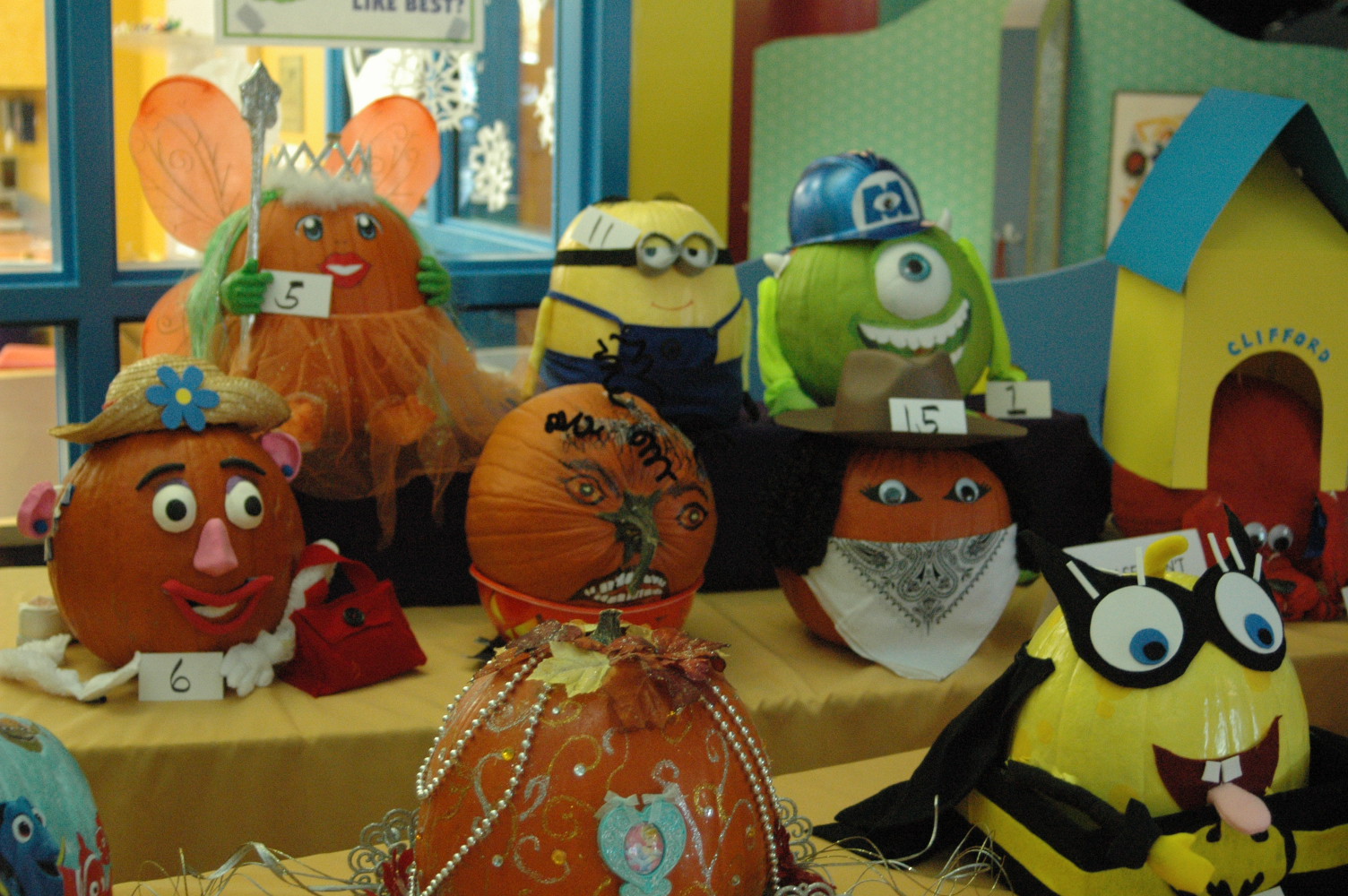
Children visiting the Museum from October 8 - 12 had a unique opportunity to learn about the voting process by casting a ballot for their favorite pumpkin. Expanding upon children's natural curiosity and delight in pumpkin decorations, DCM became the voting place for "The Great Pumpkin Decorating Contest." The submissions were hosted by Brickkicker Home Inspection Company and decorated by area realtors.

A good way to introduce the voting process is to find opportunities for children to practice voting. With younger children, the fewer the choices, the better. Hamburgers or tacos for dinner? Let's take a vote! For older children, the number or the complexity of choices can be increased. You can hold family elections on a variety of topics - where to go on vacation, what movie to watch and so on.

In any election, our own choices may not be the winning ones. When you are practicing voting with your children, make sure you explain how voting works. There's no changing your mind once the ballot is cast! Casting your vote should be a secret. You don't have to share it with anyone. You do have to honor the decision, though!

Voting for a favorite pumpkin was done by placing a ticket in the labeled box, corresponding to the pumpkin of your choice. So what's your favorite pumpkin? You have to make a decision!


And the winner is...

...pumpkin # 17, Purple Cinderella. First runner up is #8, Nemo and second runner up is #3, M & M. The pumpkins have been given to the Nurses' Station at the Pediatric Center at Edward Hospital to be presented to patients when they are discharged to go home!

Friday, October 8, 2010

Displaying Children's Art Reaps Powerful Rewards!


The best art openings in town are at DuPage Children's Museum's Good Show Gallery, a special venue for displaying children's works. The artists arrive, some in fancy dress, some straight from hockey practice, all excited to show their families the works they created in a DCM workshop. Pointing out their thoughtful creations to parents and recognizing their artistic efforts hung behind glass in an official art gallery generates tremendous pride. At one artists' reception a father shared that his daughter reminded him of the exhibit opening celebration every single day after she participated in the workshop. That morning she bounded into his room to wake him with, "Don't forget! It's tonight!"
Showcasing children's creative effort has far-reaching results. Beyond encouraging thoughtfulness in the work, gallery showings offer the opportunity to document children's increasing skills and problem-solving abilities. Our Good Show Gallery's mission is to support DCM's Scribbleosophy©, a document honoring the developmental stages in children's growing creative abilities. Displaying the work of entire classes demonstrates to parents the fact that everyone, from gifted Monet to the average doodler, goes through the same stages at roughly the same age. (While not documented, it is likely that even Rembrandt's figures looked like tadpoles at the age of 3!).

While it's cookies and juice at DCM's Good Show Gallery openings, rather than wine and cheese that are provided in Chicago's art district, be assured, the excitement and pride of every artist is a work of art.

This week's post is written by Marcia MacRae, DCM's Interdisciplinary Arts Specialist. For more information about the Good Show Gallery, contact Marcia at mmacrae@dupagechildrensmuseum.org

Monday, September 27, 2010

Educators Making Sense of Number

We hosted our 3rd annual Educators' Open House this week. About 80 educators visited with Museum staff, toured our exhibits, and explored activities associated with our Learning Lab School Programs. In addition, participants received 1.5 CEU or CPDU credits by listening to an engaging and informative presentation by Angela Andrews, Associate Professor of Math Education from National Louis University. Her topic, Making Number Make Sense, reminded us that in order to develop math understanding, we have to help children and adults understand that math is "comprehend-able not magical!"

"Never miss an opportunity to count with children," Angela told us. "Research has shown that the higher they count, the more they comprehend number." From the beginning and through kindergarten, parents, teachers and caregivers should be counting forward with children. Surprisingly, in the Pre-K years it doesn't matter if numbers are mixed-up or skipped as children are counting forward. What's important is that they keep counting forward, as high as they can go. This helps to develop the mental number line children will need for higher level math thinking. When should we start counting backwards with children? How should children write numbers? When do they start learning their math facts? Learn these answers and more when you view excerpts from Angela's presentation, available on our website soon!

If you would like more teacher workshops related to art, math or science, then DuPage Children's Museum can help! As part of a cadre of experts in integrating developmentally appropriate art, math and science activities, Early Childhood Specialist Jayne Carpenter; Interdisciplinary Arts Specialist Marcia MacRae; Chris Barry, School Programs Manager; and expert play and school facilitators have traveled all over Kane, Cook, Will and DuPage Counties to conduct hands-on workshops for caregivers and teachers of children, infants through 4th grade. These workshops can be brought to your site or hosted here at the Museum. For more information about our workshops, please contact Margaret Hanly, Associate Director of Programs (mhanly@dupagechildrensmuseum.org) or Jayne Carpenter (jcarpenter@dupagechildrensmuseum.org)

Friday, September 10, 2010

Creative Thinking Inspires Children's Engineering Abilities

The simplest materials often stimulate the most creative thinking! This summer Line Sculptures filled DCM's Studio for an entire week with colorful abstract designs, representational pictures and inspirational feats of engineering. "Inspirational" materials included paper strips of varying widths, scissors, glue sticks and small rectangular papers on which to work. A few hints on how to shape paper with accordion folds, spiral, curls and pop-up designs were all that excited visitors needed to get going.*

Children of all ages and abilities bring their unique level of skills and vision when basic materials are provided for open-ended activities. The smaller bases offered for our Line Sculptures encouraged preschoolers, who like to work flat, build up into the third dimension. Older children created engineering playgrounds, buildings and gardens, figuring out how to put wider strips at the bottom to support decorative elements on top. Designs and creativity are boundless when you keep it simple!

*One tip: Strips of wrapping paper bring fun sparks of pattern to designs.

This week's post is written by Marcia Z. MacRae, Interdisciplinary Arts Specialist for DuPage Children's Museum.

Monday, August 23, 2010

Art Explorers

As summertime is winding down, so too are our summer preschool camp programs. Our final camp of the summer gave children the opportunity to explore art in a variety of mediums. Whether children are reveling in the wet, bright-colored "squishiness" of tempera paint, creating a vista of lines and curves or thoughtfully poking or smoothing a mound of dough, they are developing artistic expression.

The Preschool Summer Camp children may not know who Jean Dubuffet is; they did, however, explore his sculpture style when we created Styrofoam peanut sculptures as we looked at images of his work. Small pieces of tissue paper, wrapped around the bottom of a dowel rod and glued on a piece of paper, gave us the same sense of color that we saw in Water Lilies by Claude Monet. And a favorite Eric Carle book, Red Fox, inspired some ideas for creating art from recycled wallpaper pieces, Eric Carle style.

Did you know the arts can make you smart? Recent research demonstrates a correlation between the arts and higher academic performance. In the report, “Learning, Arts and the Brain,” seven universities presented several studies discussing how visual arts, music, and dance training and skill impact learning (The DanaFoundation, 2008). Based on the explorations and discoveries during Art Explorers week, we would have to agree!

This week's montage of pictures shows children exploring art activities in our camp room as well as enjoying Museum exhibits with fellow campers. A BIG THANK YOU to Sue Kessler, one of our camp facilitators, for putting this montage (and some of our others) together with thought-provoking music.

Wednesday, August 11, 2010

Let's Pretend

During last week's Preschool Summer Camp, the focus was pretend. Pretending is a great way to encourage and motivate children's learning. One of the many benefits of pretending is that it gives children many opportunities to practice using their memory.

We started the week by cultivating our storytelling techniques with volunteer storyteller Joanne Chase. On Monday we created stories with story blocks and then created our own story blocks and story boards. On Tuesday we made up stories with puppets and made puppets to take home. On Wednesday we reenacted the story Caps for Sale by Esphyr Slobodkina. We used our imaginations in the exhibit neighborhoods, too: on the Main Stage, in the U-Drive and in the Cat'sTower, which are located in our Interact with Art Gallery, The Play's the Thing. By the end of the week we were making costumes and creating sets. A visit from performers of Cirque Shanghai surprised and delighted us as we watched in amazement with other Museum visitors.


For more information about pretend play, we recommend two of our favorite staff resource books at DCM. Both books can be ordered through DCM's Shop and Grow Program.

Einstein Never Used Flashcards
by Kathy Hirsh-Pasek, Roberta M. Golinkoff and Diane E. Ayer

Awakening Children's Mind
s: How Parents and Teachers Can Make a Difference by Laura E. Berk

Tuesday, August 3, 2010

Cool Chemical Concoctions

Bubble, fizz, ooze! These were some of the results last week at our Cool Chemical Concoction Mini-Camp for 7-9 year old children. At one of the four mini-camps for younger school-age children held this summer, children experimented with common household "chemicals" to learn about the power of CO2 gas, how yeast makes dough rise, how to grow crystals, how to make several different cool slimes and much more!

You don't need to be a scientist to explore science! Because of children's natural curiosity, it's easy to get them interested in science. Visit your local library and look up books about kitchen chemistry. Some of our favorites include Science Experiments You Can Eat by Vicki Cobb, Kitchen Chemistry: A Book of Science Experiments by Evan Moor and Kid Chemistry by Sandra Ford Grove. You can find these books on-line through our Shop 'n' Grow Program.

So - discover what's inside your cabinets for experiments. Don't forget to stand back when you drop the Mint Mentos® into the Diet Coke.

Wednesday, July 21, 2010

Play with Water and Bubbles!

In everyday life water spouts from faucets, drains from tubs and rains from above. And inevitably, if you are a child it spills! During last week's Preschool Summer Camp children redirected, captured, and controlled water. With multiple approaches and myriad of solutions to any challenge, playing with water and bubbles is discovery learning at its best.

For information about the science behind playing with water and bubbles, click here.

Here's some of the learning and fun we had in the Water and Bubbles Preschool Camp last week.


For information about our Preschool Summer Camps, click here.

Friday, July 9, 2010

Make It Move through Play

A child's fascination with moving objects can inspire numerous scientific observations and experimentation with some of the basic concepts of physics. Through active participation with things that move, children gain confidence, make comparisons, problem solve, apply concepts of force and motion, use creativity, work, plan and design.

During last week's Preschool Summer Camp, Make It Move, children worked both individually and collaboratively to experiment with how objects move. We used salad spinners to move paint. We used toy cars and toy trains to observe tracks in water, paint and shaving cream. We even rode a tricycle and pushed a cart through paint and observed the patterns the wheels made. We experimented with inclined planes by rolling items down a ramp to see which one would roll, slide or stay put. We also made our own slides out of tubes and tape. The book, Roll, Slope or Slide: A Book about Ramps by Roald Dahl and Michael Lewis, helped clarify our experiments. Two other favorite stories during the week were Rattletrap Car by Phyllis Root and Jill Barton and Mama Zooms by Jane Cowen-Fletcher.

Want to play at home? Stop and watch goods being moved up and down delivery truck ramps. Then go to a park and try out the varying sized slides. Which slide makes objects and children go faster? Why? Have your child move his big wheel or wagon through water. Turn the wheel and watch the path change. Go along for a walk while your child pulls the wagon or rides a tricycle. Is the road an inclined plane? How easy or hard is it to go up the road?

For more information about physics, force, motion and moving objects, read a previous post here.

Want to know more about our Preschool Summer Camps? Camps run weekly through August 20th. Click here for registration information.

Enjoy some pictures from Preschool Summer Camp, Make it Move!


Tuesday, June 15, 2010

Exploring Physics in Childhood

How did you explore the concepts of physics when you were a child? Do you remember the toy, Slinky? This was a toy that helped you intuitively learn physics. My sisters and I each owned a Slinky and had races with them down the stairs in our house. We were experimenting with how fast or slowly we pushed the Slinky off the steps, in actuality, an inclined plane. A physicist would have told us we were experimenting with force versus distance.

You don't have to be a physicist to explore the concepts of physics; you just need the right materials for exploration and discovery. Some concepts of basic physics involve exploring motion, gravity, friction and speed while using simple machines such as wheels, gears, pulleys, inclined planes, wedges, screws and levers. The exhibits in Make it Move (MIM) were developed so that children could explore some concepts of basic physics while playing with simple machines. As children play with the exhibits in MIM, they can begin to intuitively understand some of these concepts and, with the support of their grown-up play partners, learn the vocabulary to describe them. Look at how many words (bold) we can use to describe simple machines and some of the basic concepts in physics.

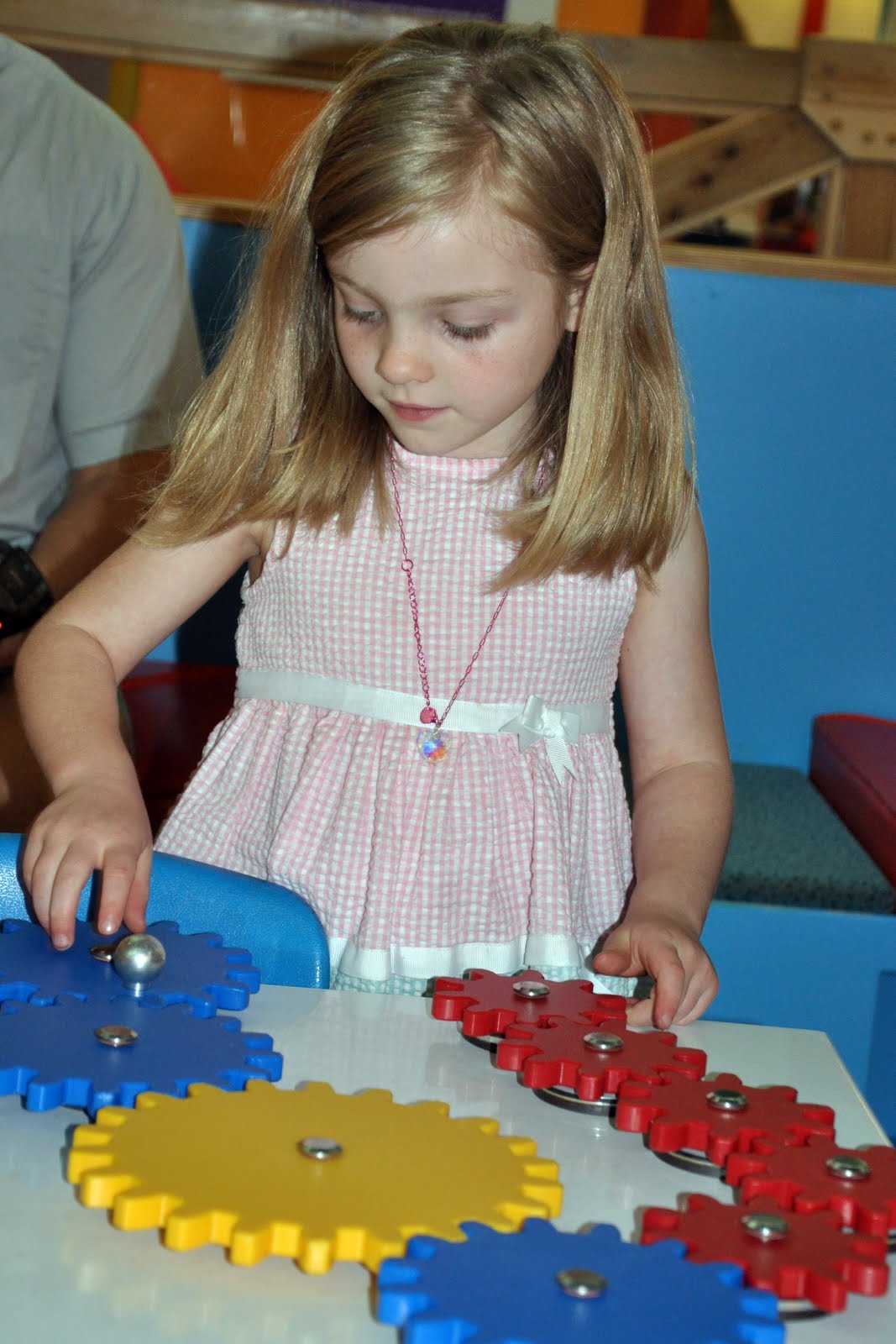
Children explore gears at our Gear Table. Here they discover that a gear is a wheel with teeth, which allow it to interlock and turn another gear. They may also notice the ratio between a bigger and smaller gear.

Playing at our Cam Ball Lifter, children observe cams, which are wheels or gears with an offset axle used to make something happen in a specific order. Here it does just as the name implies; it lifts the ball towards the funnel for increasingly greater energy in motion for the awaiting ramps.

Speaking of ramps, there are lots of opportunities to discover that ramps are inclined planes that help the speed of a ball move more easily, slower or faster. A simple machine that does the work for us! After all, isn't that what working with simple machines is all about, that is, using a force to move an object a distance?

The momentum of the object at the Experimentation Station may vary depending upon what object is chosen. Even our youngest visitors can be observed experimenting with balls and spools down one ramp and trying out the car on the magnetic levitation (mag lev) ramp.

To learn more about the design and building of the exhibits in Make it Move, read an interview with Mark Wickart, Exhibit Fabrication and Maintenance Manager; and Peter Crabbe, Associate Director of Exhibits and Design, here.

If you and your child would like to explore (and have fun) with a Slinky, you can purchase one in our Explorer Store.